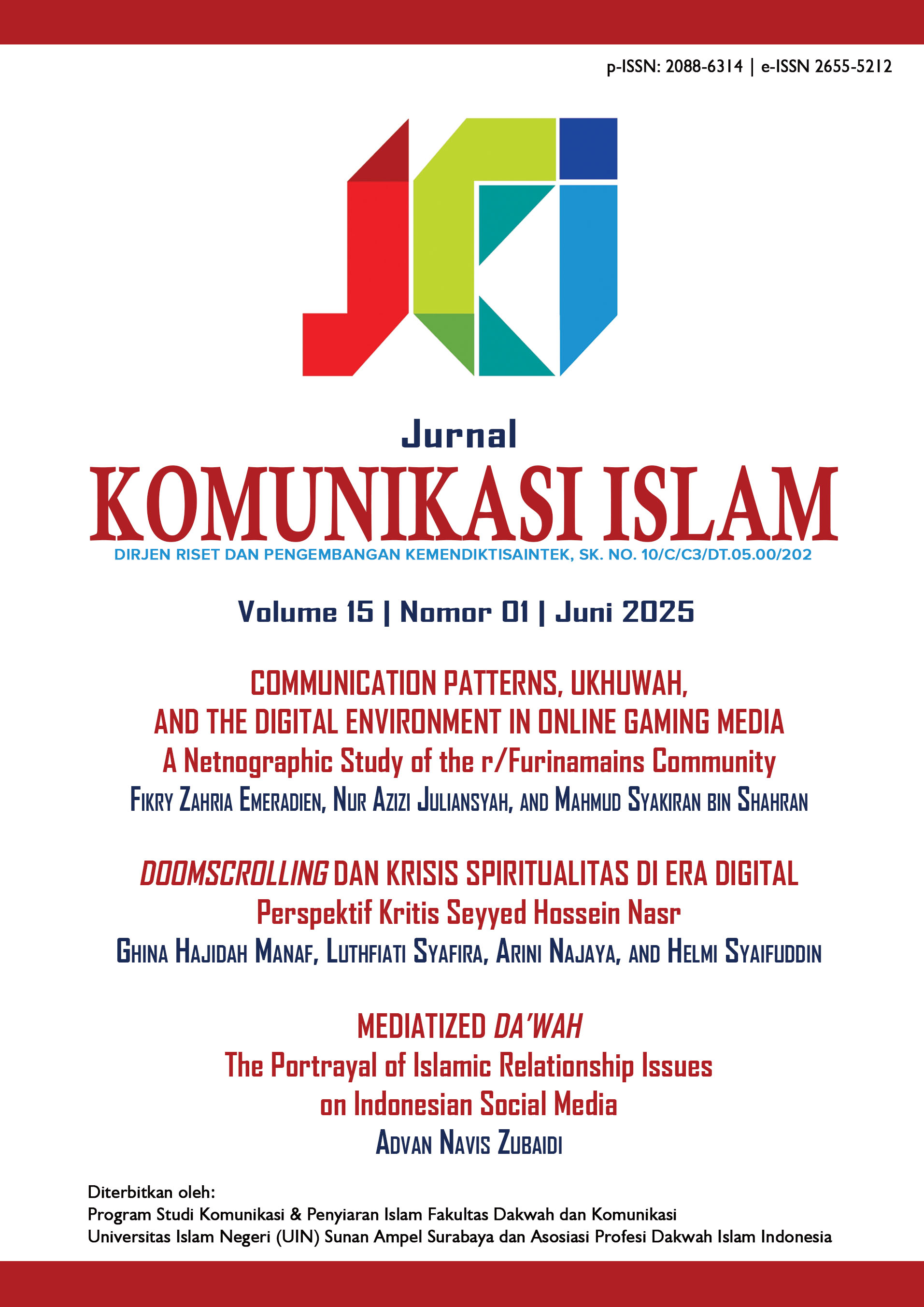
Communication Patterns, Ukhuwah, and the Digital Environment in Online Gaming Media: A Netnographic Study of the r/Furinamains Community
DOI:
https://doi.org/10.15642/jki.2025.15.1.1-25Keywords:
Digital communication; netnography; online gaming; subreddit; media communityAbstract
This study examines the dynamics of communication patterns within the Reddit community r/furinamains, which centers around Furina, a character from the game Genshin Impact. The research aims to gain a deeper understanding of how Furina’s fans interact within this virtual space. A qualitative netnographic approach was employed as the research method. Data were collected through observation and documentation. The subjects of this study include posts, comments, and discussions that take place within the r/furinamains subreddit. The findings reveal that this interactive space fosters identity formation, digital solidarity, and collective emotional expression within the realm of popular media culture. The discussion considers the ethical context of communication and the values of ukhuwah (brotherhood) that support the creation of a healthy digital environment.
Downloads
References
Al-Qardawi, Y. (2006). Islamic Awakening Between Rejection and Extremism. The International Institute of Islamic Thought.
Barthes, R. (1972). Mythologies. Hill and Wang.
Barton, D., & Lee, C. (2013). Language Online: Investigating Digital Texts and Practices. Routledge.
Baym, N. K. (2015). Personal Connections in the Digital Age (2nd ed.). Polity Press.
Blommaert, J. (2010). The Sociolinguistics of Globalization. Cambridge University Press.
Boellstorff, T. (2015). Coming of Age in Second Life: An Anthropologist Explores the Virtually Human. Princeton University Press.
Boyd, danah. (2014). It’s Complicated: The Social Lives of Networked Teens. Yale University Press.
Braun, V., & Clarke, V. (2006). Using thematic analysis in psychology. 3(2), 77–101. https://doi.org/10.1191/1478088706qp063oa
DeAndrea, D., Shaw, A., & Levine, T. R. (2012). Online Language: The Role of Culture in Self-Expression and Self-Construal on Facebook. Journal of Language and Social Psychology, 29(4), 425–442. http://dx.doi.org/10.1177/0261927X10377989
Fiske, J. (1992). The Cultural Economy of Fandom. Routledge.
Gee, J. P. (2004). What Video Games Have to Teach Us About Learning and Literacy. Palgrave Macmillan.
Gee, J. P. (2005). Why Video Games are Good for Your Soul: Pleasure and Learning. Commond Ground.
Gillespie, T. (2018). Custodians of the Internet: Platforms, Content Moderation, and the Hidden Decisions That Shape Social Media. Yale University Press.
Graham, T., & Rodriguez, A. (2021). The Sociomateriality of Rating and Ranking Devices on Social Media: A Case Study of Reddit’s Voting Practices. Social Media + Society, 7(3). https://doi.org/ 10.1177/20563051211047667
Herring, S. (2019). The Coevolution of Computer-Mediated Communication and Computer-Mediated Discourse Analysis: New Insights and Future Directions. In Analyzing Digital Discourse (pp. 25–67). Oxford University Press.
Ito, M., Baumer, S., Bittanti, M., boyd, danah, & Cody, R. (2010). HANGING OUT, MESSING AROUND, AND GEEKING OUT Kids Living and Learning with New Media. MIT Press.
Jenkins, H. (2006). Convergence Culture: Where Old and New Media Collide. New York University Press.
Jenkins, H., Ford, S., & Green, J. (2013). Spreadable Media: Creating Value and Meaning in a Networked Culture. New York University Press.
Keating, E., & Sunakawa, C. (2010). Participation cues: Coordinating activity and collaboration in complex online gaming worlds. Language in Society, 39(3), 331–356. https://doi.org/10.1017/ S0047404510000217
Kozinets, R. V. (2010). Netnography: Doing Ethnographic Research Online. Sage Publications.
Lamerichs, N. (2018). Productive Fandom: Intermediality and Affective Reception in Fan Cultures (Transmedia). Amsterdam University Press.
Matias, J. N. (2019). The Civic Labor of Volunteer Moderators Online. Social Media + Society, 5(2). https://doi.org/10.1177/ 2056305119836778
Nasrullah, R. (2023). MEDIA SOSIAL, Perspektif Komunikasi, Budaya, dan Sosioteknologi Edisi Revisi. Simbiosa Rekatama Media.
Papacharissi, Z. (2015). Affective Publics: Sentiment, Technology, and Politics (Oxford Studies in Digital Politics) 1st Edition. Oxford University Press.
Putnam, R. D. (2000). Bowling Alone: The Collapse and Revival of American Community. Simon & Schuster.
Rheingold, H. (2000). The Virtual Community: Homesteading on the Electronic Frontier. MIT Press.
Shifman, L. (2014). Memes in digital culture. The MIT Press.
Sproull, L. (1991). Connections: New Ways of Working in the Networked Organization. MIT Press.
Van Dijck, J. (2013). The Culture of Connectivity: A Critical History of Social Media 1st Edition. Oxford University Press.
Walther, J. B. (2011). Theories of computer-mediated communication and interpersonal relations. In M. L. Knapp & J. A. Daly (Eds.), The Sage handbook of interpersonal communication (4th ed., pp. 443–479). Sage.
Wellman, B., & Gulia, M. (1999). Net Surfers Don’t Ride Alone: Virtual Communities As Communities. In Networks In The Global Village (1st ed., p. 36). Routledge.
Willy. (2022). The Power of Wibu, Pemain Genshin Impact Di Indonesia Terbanyak Ke-4! UP Station. https://www.upstation. asia/wibu-pemain-genshin-impact-indonesia-terbanyak-ke-4/
Downloads
Published
How to Cite
Issue
Section
License
Copyright (c) 2025 Fikry Emeraldien, Nur Azizi Juliansyah, Mahmud Syakiran bin Shahran

This work is licensed under a Creative Commons Attribution-ShareAlike 4.0 International License.