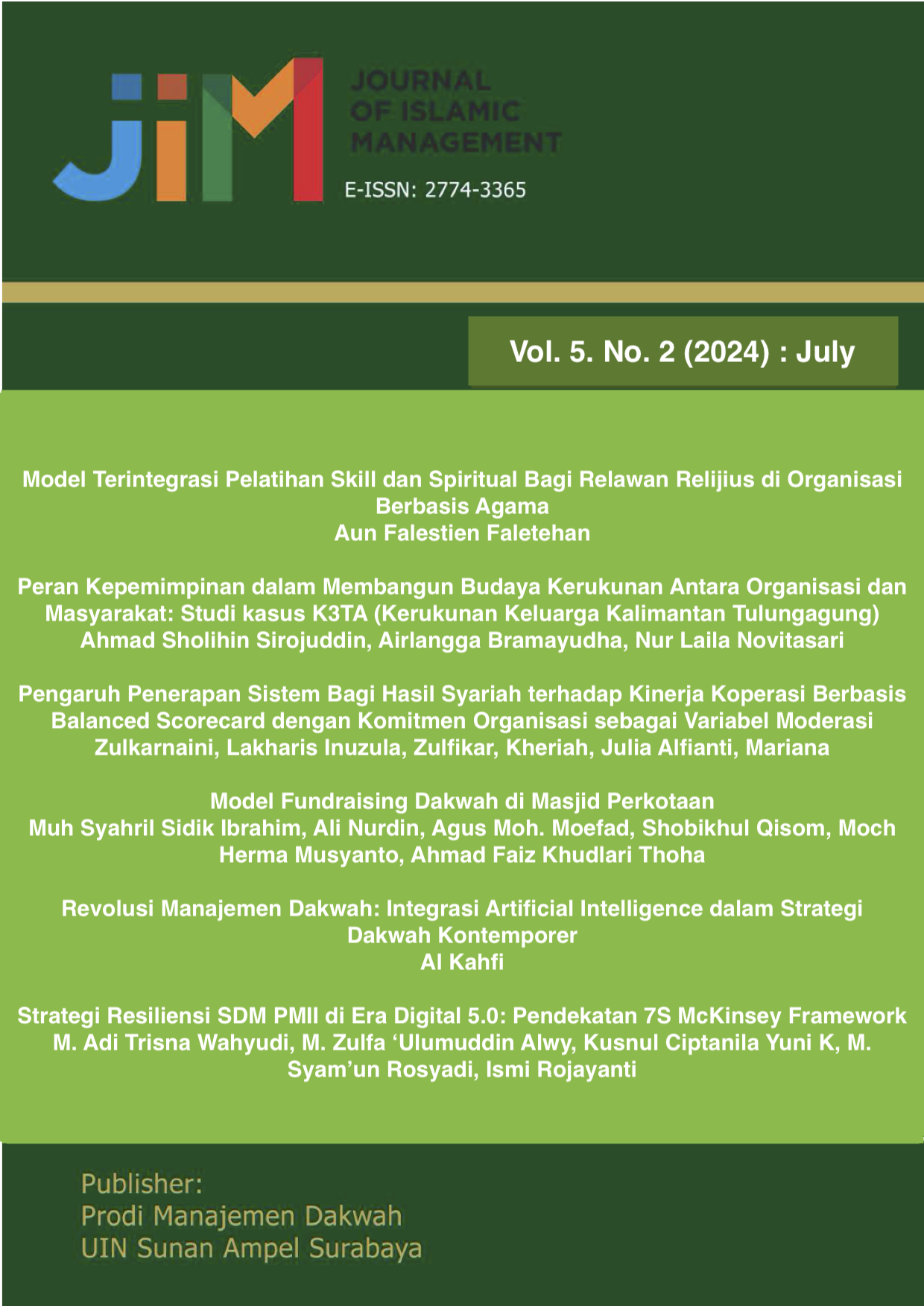
Revolusi Manajemen Dakwah: Integrasi Artificial Intelligence dalam Strategi Dakwah Kontemporer
DOI:
https://doi.org/10.15642/jim.v2i2.1990Keywords:
Artificial Intelligence, Da'wah Management, Da'wah StrategyAbstract
In the digital era, artificial intelligence (AI) plays an increasingly significant role in Islamic da'wah management. This research examines how AI can be integrated into contemporary da'wah strategies to increase the effectiveness of Islamic propagation. The main focus of the research includes Big Data analysis to understand religious trends, personalized da'wah content based on audience preferences, the development of an Islamic chatbot for more responsive interactions, and the automation of da'wah content distribution through digital media. The research method used is a literature review approach and a comparative analysis between conventional and AI-based da'wah methods. The results show that AI can increase the reach and efficiency of da'wah by providing a more interactive and relevant experience for the audience. However, AI implementation also faces challenges, such as algorithmic bias, limitations in understanding the spiritual and emotional aspects of da'wah, and the need for content validation to ensure it remains in line with Islamic principles. Furthermore, collaboration between religious scholars, academics, and technology practitioners is crucial to ensure that AI is used ethically and responsibly in da'wah. This study concludes that AI has great potential to support Islamic preaching in the digital era, but it must remain a tool that complements the role of ulama and da'i, not replace them. With wise integration and proper oversight, AI can be an innovative solution to strengthen da'wah that is more inclusive, adaptive, and relevant to current developments.
Downloads
References
Al Kahfi, Kholis Ali Mahmud, A. (2024). Transformation Of Da’wah In The Digital Era:
Modern Strategies In Optimizing Technology-Based Da’wah Management. Jdk: Jurnal
Dakwah Dan Komunikasi, 9(2), 63–79.
Apriliani, Dyah, Sharfina Febbi Handayani, And I. T. S. (2023). “Implementasi Natural
Language Processing (Nlp) Dalam Pengembangan Aplikasi Chatbot Pada Smk Ype
Nusantara Slawi.” Techno. Com, 22(4).
Ardo, E., Diansah, A., & Nurdin, A. (2024). Urgensi Evaluasi Dalam Komunikasi Dakwah
Menurut Tafsir Ibnu Katsir Dalam Qs . Al-Hasyr Ayat 18-19. Ta’wiluna: Jurnal Ilmu Al-
Qur’an, Tafsir Dan Pemikiran Islam, 5(3).
Aris Saefulloh. (2012). Cyberdakwah Sebagai Media Alternatif Dakwah. Islamica: Jurnal Studi
Keislaman, 7(1).
Arsenyan, Jbid, And A. P. (2023). “Artificial Intelligence Research In Management: A
Computational Literature Review.” Ieee Transactions On Engineering Management 71, 5088-
Asiva Noor Rachmayani. (2015). Management Materi Dakwah Dalam Perkembangan Media
Sosial. Ath-Thariq: Jurnal Dakwah Dan Komunikasi, 3(2), 6.
Belhaj, A. (2024). Contesting Power As Political Theology : Traditionalist Islamic. Licensee
Mdpi, Basel, Switzerland., 1–18.
Bhowmick, P. K., Das, P. P., Chakrabarti, P. P., & Sanyal, D. K. (2022). National Digital
Library Of India: Democratizing Education In India. Communications Of The Acm, 65(11),
–61. Https://Doi.Org/10.1145/3550480
Daniel, R. (2020). Ilmu Dakwah: Suatu Pengantar (Abqarie Pr). Abqarie Press.
Edy Sutrisno. (2022). Dakwah Digital Di Era Milenial. (Guepedia (Ed.)). Guepedia.
Efendi, E., Fatin, M. A., & Sari, N. F. (2023). Daya Tarik Media Digital Sebagai Media
Dakwah Untuk Generasi Milenial. Visa: Journal Of Vision And Ideas, 3(3), 1041–1048.
Https://Doi.Org/10.47467/Visa.V3i3.5468
Downloads
Published
How to Cite
Issue
Section
License
Copyright (c) 2025 Al Kahfi

This work is licensed under a Creative Commons Attribution-ShareAlike 4.0 International License.