
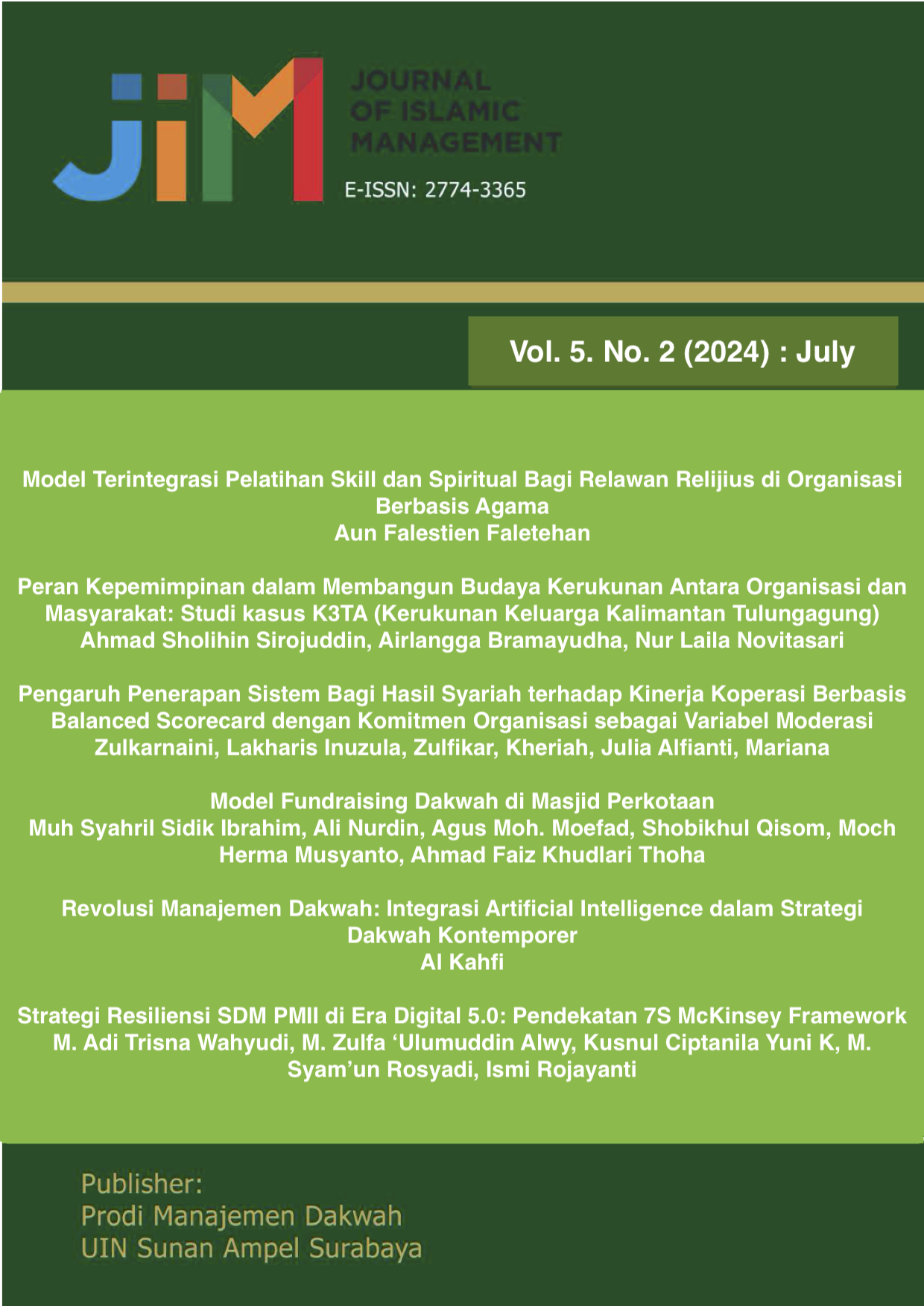
Model Fundraising Dakwah di Masjid Perkotaan
DOI:
https://doi.org/10.15642/jim.v2i2.1995Keywords:
Fundraising Strategy, Mousque Management, Donation ManagementAbstract
Mosques play a pivotal role in the socio-economic development of Muslim communities, particularly through effective fundraising management. Mosque fundraising is not only a tool for collecting donations but also a means to achieve economic empowerment and financial sustainability for religious and social programs. This study analyzes mosque fundraising strategies in Surabaya, focusing on community-based, partnership-based, digital, and institutional models. It examines how Masjid Rahmat Kembang Kuning, Masjid Cheng Hoo, and Masjid Al Falah implement diverse donation management approaches, ensure financial transparency, and build trust among congregants. Utilizing a qualitative methodology with a Grounded Theory approach, data were collected through in-depth interviews, direct observations, and document analysis involving mosque administrators, donors, and active congregants. Findings reveal that community- based fundraising initiatives like the Warung Dzuhur program and Haul Mbah Karimah effectively foster congregational engagement through collective participation. Partnership-based fundraising, exemplified by Masjid Cheng Hoo, secures financial stability via corporate sponsorships and foundation collaborations. Digital fundraising expands donation channels through QRIS, social media, and online payment systems, enhancing transparency and donor confidence. The study concludes that innovative and participatory fundraising strategies grounded in Islamic management principles strengthen mosque financial sustainability, enhance congregational trust, and empower mosques as independent and socially impactful institutions. The findings offer a strategic framework for mosques to optimize fundraising while maintaining Sharia-compliant financial governance and promoting community empowerment.
Downloads
References
Afif, M. (2020). Fungsi Masjid Dalam Mengelola Dana Ziswah Sebagai Instrumen
Pemberdayaan Ekonomi Umat. Islamic Economics and Philanthropy, 03(02), 749–772.
Barthelemy, F. (2019). Strategi Komunikasi Crowdfunding melalui Media Sosial
(Crowdfunding Communication Strategy through Social Media). JURNAL
IPTEKKOM : Jurnal Ilmu Pengetahuan & Teknologi Informasi, 21(2), 155.
https://doi.org/10.33164/iptekkom.21.2.2019.155-168
Biduri, S., Hariyanto, W., & Izza Noor Abidin, F. (2023). Digitalisasi Keuangan Menuju
Akuntabilitas Dan Transparansi Pada Masjid Al-Manar Sepanjang Kabupaten Sidoarjo.
Jukeshum: Jurnal Pengabdian Masyarakat, 3(2), 260–266.
https://doi.org/10.51771/jukeshum.v3i2.531
Gioia, D. A., Corley, K. G., & Hamilton, A. L. (2013). Seeking Qualitative Rigor in Inductive
Research. Organizational Research Methods, 16(1), 15–31.
https://doi.org/10.1177/1094428112452151
Kango, A. (2015). Dakwah Di Tengah Komunitas Modern. Jurnal Dakwah Tabligh, 16(1), 42–
M. Drea, K., Brown, M., & F. Sacco, D. (2021). Functional altruism among agreeable and
narcissistic donors. Psihologijske Teme, 30(1), 125–143.
https://doi.org/10.31820/pt.30.1.7
Munawara, M., Rahmanto, A., & Satyawan, I. A. (2020). Pemanfaatan Media Digital untuk
Dakwah Pesantren Tebuireng. KOMUNIKA: Jurnal Dakwah Dan Komunikasi, 14(1), 29–
https://doi.org/10.24090/komunika.v14i1.3226
Nur’aini, H., & Ridla, M. R. (2015). Pengaruh Kualitas Pelayanan, Citra Lembaga Dan
Religiusitas Terhadap Minat Muzakki UNtuk Menyalurkan Zakat Profesi. Jurmal MD,
–228.
Downloads
Published
How to Cite
Issue
Section
License
Copyright (c) 2025 Muh Syahril Sidik Ibrahim Mauludi, Ali Nurdin, Agoes Moh. Moefad, Shobikhul Qisom, Moch Herma Musyanto, Ahmad Faiz Khudlari Thoha

This work is licensed under a Creative Commons Attribution-ShareAlike 4.0 International License.