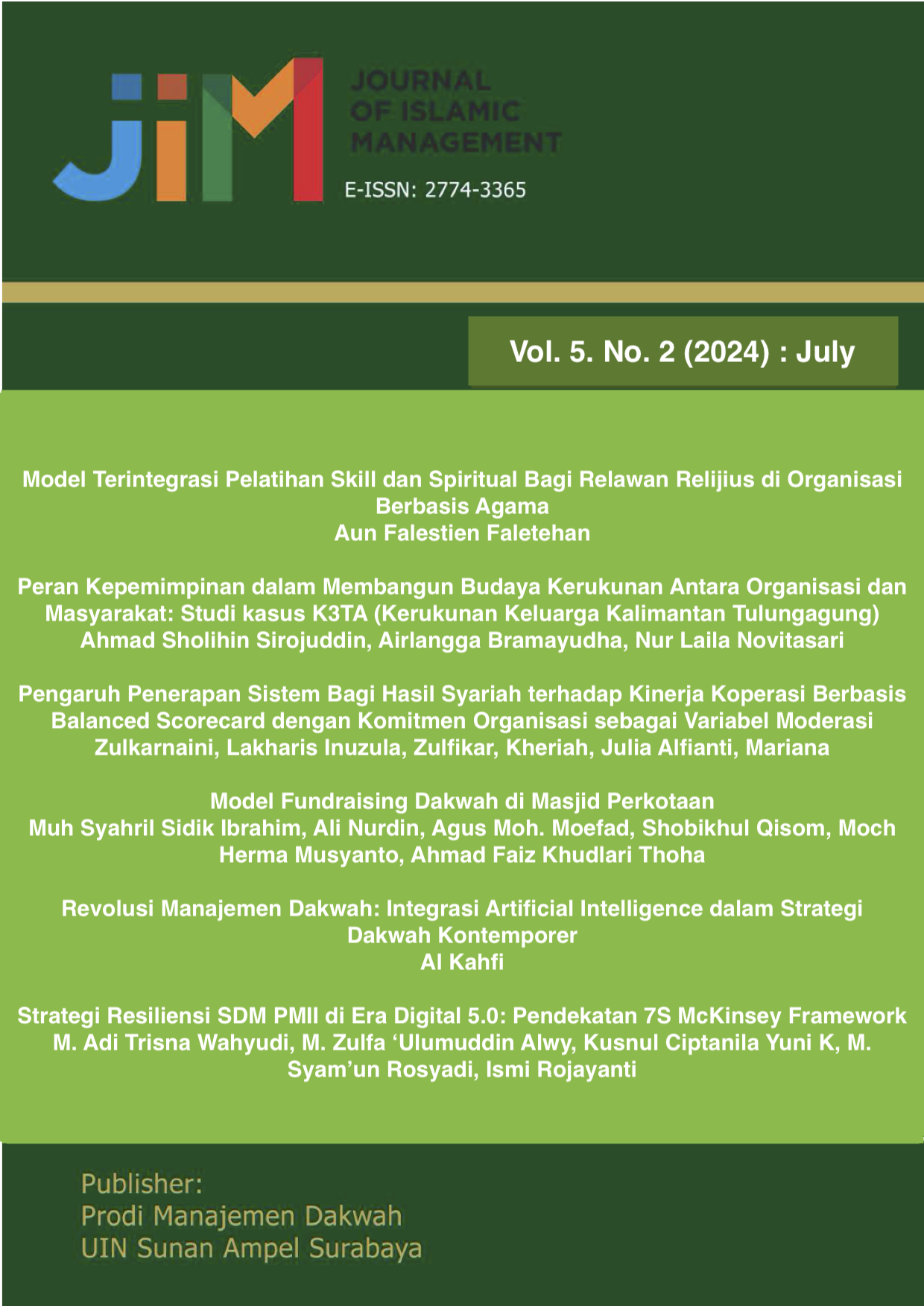
Pengaruh Penerapan Sistem Bagi Hasil Syariah terhadap Kinerja Koperasi Berbasis Balanced Scorecard dengan Komitmen Organisasi sebagai Variabel Moderasi
DOI:
https://doi.org/10.15642/jim.v2i2.2004Keywords:
Balanced Scorecard, Sharia Cooperative, Profit-Sharing System, Organizational CommitmentAbstract
This study investigates the implementation of cooperative performance measurement using the Balanced Scorecard (BSC) framework, with a specific focus on the influence of the Sharia-based profit-sharing system and the moderating role of organizational commitment. Drawing on a sample of 33 Sharia-based cooperatives in Lhokseumawe, the study employs multiple linear regression and Moderated Regression Analysis (MRA) to test the proposed model. The findings reveal a significant positive impact of the Sharia-based profit-sharing system on BSC-based performance (path coefficient = 0.573; p < 0.001), as well as a strong influence of organizational commitment (path coefficient = 0.568; p < 0.001). Notably, the interaction effect between profit-sharing and organizational commitment is also significant (path coefficient = 0.107; p = 0.004), indicating that high organizational commitment enhances the effectiveness of Sharia-compliant systems in driving BSC performance. This research contributes to the limited body of literature that integrates Islamic financial principles with strategic performance frameworks, offering a novel perspective on how religious-based financial systems can be synergized with modern management tools to improve cooperative performance.
Downloads
References
Abbas, A., & Arizah, A. (2019). Marketability , profitability , and profit-loss sharing : evidence
from sharia banking in Indonesia. Asian Journal of Accounting Research, 4(2), 315–326.
https://doi.org/10.1108/AJAR-08-2019-0065
Arifai, M., Tran, A. T., Moslehpour, M., & Wong, W. K. (2018). Two-tier board system and
Indonesian family owned firms performance. Management Science Letters, 8(7), 737–754.
https://doi.org/10.5267/j.msl.2018.5.011
Ayele, N. F., & Singh, M. (2024). Beyond financials: Examining the impact of customer focus,
internal processes, and learning & growth on the sustainable performance of
commercial banks—Moderating role of management commitment. Business Strategy
& Development. https://api.semanticscholar.org/CorpusID:273724318
Baer, M. D., Bundy, J., Garud, N., & Kim, J. K. (2018). The benefits and burdens of
organizational reputation for employee well-being: A conservation of resources
approach. Personnel Psychology, 71(4), 571–595. https://doi.org/10.1111/peps.12276
Chalmeta, R., & Estevez, M. F. (2023). Developing a Business Intelligence Tool for
Sustainability Management. Business Process Management Journal, 29(8), 188–209.
https://doi.org/10.1108/BPMJ-03-2023-0232
Chang, C. L., & Arisanti, I. (2022). How does Spiritual Leadership Influences Employee Well-
Being? Findings from PLS-SEM and FsQCA. Emerging Science Journal, 6(6), 1358–1374.
https://doi.org/10.28991/ESJ-2022-06-06-09
Cignitas, C. P. (2022). Balanced Scorecard: the Key To Employee Well-Being - the Impact of
Balanced Scorecard on Employee Well-Being: the Case of State of Michigan-Usa.
International Journal of Business & Management, X(1).
https://doi.org/10.20472/bm.2022.10.1.001
Cline, K. D. (2000). Defining the Implementation Problem: Organizational Management
versus Cooperation. Journal of Public Administration Research and Theory, 10(3), 551–571.
https://doi.org/10.1093/oxfordjournals.jpart.a024281
Fajri, H., Mariana, M., Kusumo, Y. W., Abral, E., & Alfianti, J. (2025). The Influence Of
Financial Literacy On The Quality Of Economic Decision Making Among Urban
Communities. Jurnal Ekonomi Pendidikan Dan Kewirausahaan, 13(1), 147–164.
Downloads
Published
How to Cite
Issue
Section
License
Copyright (c) 2025 Zulkarnaini Zulkarnaini, Lakharis Inuzula, Zulfikar Zulfikar, Kheriah Kheriah, Julia Alfianti , Mariana Mariana

This work is licensed under a Creative Commons Attribution-ShareAlike 4.0 International License.