
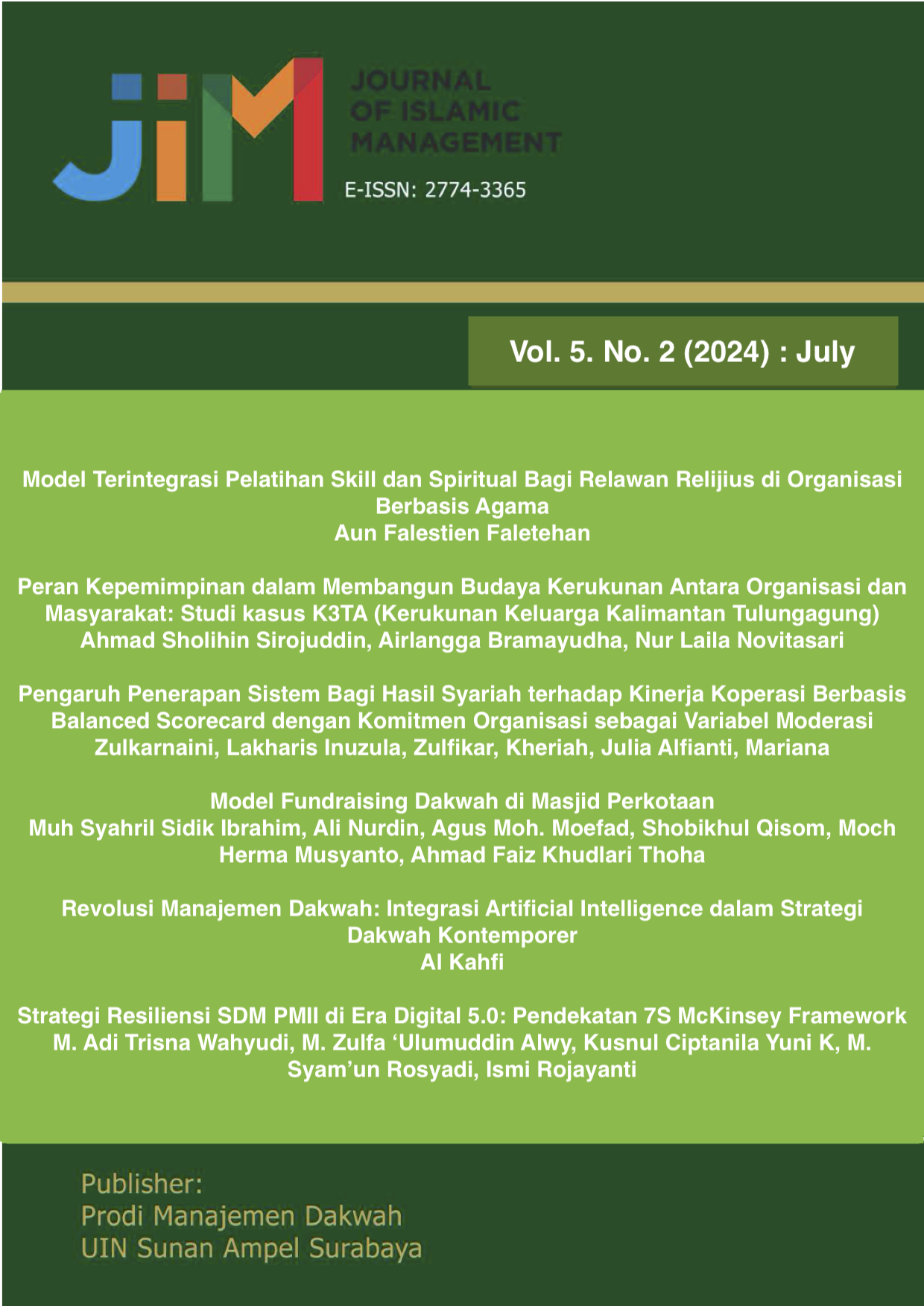
Model Terintegrasi Pelatihan Skill dan Spiritual Bagi Relawan Relijius di Organisasi Berbasis Agama
DOI:
https://doi.org/10.15642/jim.v2i2.2136Keywords:
Skill Training, Spiritual Training, Religious Volunteer, Faith-Based OrganizationAbstract
This study examines the integration of spiritual and skills training in volunteer training programs within faith-based organizations in Surabaya. A qualitative approach with a multi-case study design was used to explore the dynamics and context of training in two different faith-based organizations in Surabaya, namely an Islamic and a Christian organization. A total of 22 volunteers (14 from the Islamic organization and 8 from the Christian organization) participated in the study. Data were collected through semi- structured interviews, non-participant observation, and training document analysis. Data analysis was conducted using thematic analysis. The results show that the integration of skills and spiritual training is carried out flexibly, with religious values being incorporated into skills training. On the other hand, skills training focuses on developing the technical and social capacities of the volunteers, while spiritual training emphasizes strengthening the intention and sincerity in their actions. The findings reveal that these two types of training complement each other and play a crucial role in shaping volunteers who are not only technically competent but also possess spiritual integrity. This holistic approach strengthens the loyalty and long-term commitment of volunteers, while also having a positive impact on their personal lives.
Downloads
References
Berger, J. (2003). Religious nongovernmental organizations: An exploratory analysis.
Voluntas, 14(1), 15–40. https://doi.org/10.1023/A:1022988804887
Braun, V., & Clarke, V. (2019). Reflecting on reflexive thematic analysis. Qualitative Research
in Sport, Exercise and Health, 11(4), 589–597.
https://doi.org/10.1080/2159676X.2019.1628806
Brudney, J. L., & Meijs, L. C. P. M. (2009). It ain’t natural: Toward a new (Natural) resource
conceptualization for volunteer management. Nonprofit and Voluntary Sector Quarterly,
(4), 564–581. https://doi.org/10.1177/0899764009333828
Cicchinelli, A., & Pammer-Schindler, V. (2022). What makes volunteer mentors tick? A case
study in a preparatory online training course. Journal of Workplace Learning, 34(3), 256–
https://doi.org/10.1108/JWL-12-2020-0191
Clarke, M., & Ware, V.-A. (2015). Understanding faith-based organizations: How FBOs are
contrasted with NGOs in international development literature. Progress in Development
Studies, 1, 37–48.
Clarke, V., & Braun, V. (2017). Thematic analysis. The Journal of Positive Psychology, 12(3), 297–
https://doi.org/10.1080/17439760.2016.1262613
Clary, E. G., Snyder, M., Ridge, R. D., Copeland, J., Stukas, A. A., Haugen, J., & Miene, P.
(1998). Understanding and assessing the motivations of volunteers: A functional
approach. Journal of Personality and Social Psychology, 74(6), 1516–1530.
https://doi.org/10.1037/0022-3514.74.6.1516
Corbin, J. M., & Strauss, A. L. (1990). Grounded theory research: Procedures, canons, and
evaluative criteria. Qualitative Sociology, 13(1), 3–21.
https://doi.org/10.1007/BF00988593
Eisenhardt, K. M., & Graebner, M. E. (2007). Theory building from cases: Opportunities
and challenges. Academy of Management Journal, 50(1), 25–32.
Downloads
Published
How to Cite
Issue
Section
License
Copyright (c) 2025 Aun Falestien Faletehan

This work is licensed under a Creative Commons Attribution-ShareAlike 4.0 International License.