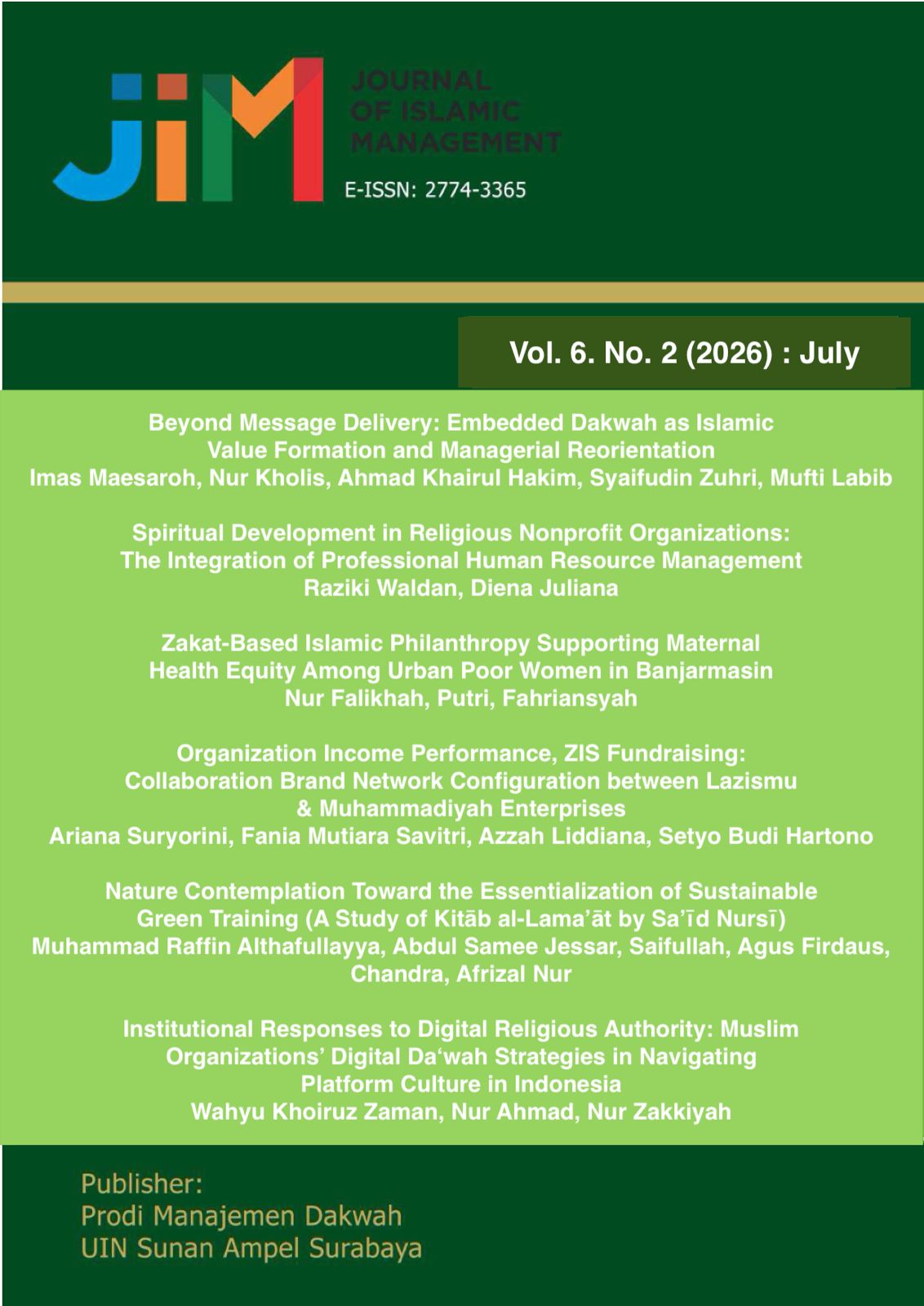
Zakat-Based Islamic Philanthropy Supporting Maternal Health Equity Among Urban Poor Women in Banjarmasin
DOI:
https://doi.org/10.15642/jim.v6i2.2610Keywords:
Zakat-based Islamic philanthropy, Collaborative governance, Urban poor womenAbstract
This study examines the role of zakat-based Islamic philanthropy in supporting maternal health equity among urban poor women in Banjarmasin within the framework of the Sustainable Development Goals (SDGs). Maternal health disparities indicate that vulnerable women continue to face barriers in accessing reproductive health services. Using a descriptive qualitative case study, this research was conducted at the Klinik Pratama Gratis Dhuafa Tersenyum managed by the Dhuafa Tersenyum Foundation. Data were collected through in-depth interviews, observations, and document analysis. The findings show that zakat, infaq, and sadaqah (ZIS) funds were utilised to provide free antenatal care, modern contraceptive services, and safe childbirth assistance. This zakat-based model complements government maternal health policies by reducing financial barriers, strengthening continuity of care, and supporting the achievement of SDG targets 3.1 and 3.7. The study highlights Islamic philanthropy as a socio-religious mechanism for equitable and sustainable maternal health policy implementation.
Downloads
References
Ahmed, H. (2004). Role of Zakah and Awqaf in Poverty Alleviation. Islamic Research and Training
Institute.
Ansell, C., & Gash, A. (2008). Collaborative Governance in Theory and Practice. Journal of
Public Administration Research and Theory, 18(4), 543–571.
https://doi.org/10.1093/jopart/mum032
Aziz, Y., Mansor, F., Waqar, S., & Haji Abdullah, L. (2020). The nexus between zakat and
poverty reduction, is the effective utilization of zakat necessary for achieving SDGs: A
multidimensional poverty index approach. Asian Social Work and Policy Review, 14(3),
–247. https://doi.org/10.1111/aswp.12212
Badan Pusat Statistik. (2016). Profil Penduduk Indonesia Hasil SUPAS 2015 (D. et all
Handiyatmo (ed.)). Badan Pusat Statistik.
https://www.bps.go.id/id/publication/2016/11/30/63daa471092bb2cb7c1fada6/pr
ofil-penduduk-indonesia-hasil-supas-2015.html
Badan Pusat Statistik. (2022). Provinsi Kalimantan Selatan dalam Angka Tahun 2022.
Badan Pusat Statistik. (2024). Indonesian-Sustainable-Development-Goals-Indicators-2024.
In Badan Pusat Statistik: Vol. Volume 8,.
https://www.bps.go.id/en/publication/2024/12/31/936a26d5d2b168b9971d3b02/i
ndonesian-sustainable-development-goals-indicators-2024.html
Badan Pusat Statistik. (2025). Indeks Pembangunan Manusia ( IPM ) 2025 (Issue 104).
Badan Pusat Statistik Kota Banjarmasin. (2025). Banjarmasin Dalam Angka 2025.
Badan Pusat Statistik Provinsi Kalimantan Selatan. (2022). Indikator Tujuan Pembangunan
Berkelanjutan Provinsi Kalimantan Selatan 2021.
BKKBN, K. K. dan P. K. (2025). Siperindu (Sistem Informasi Peringatan Dini Pengendalian
Penduduk). https://siperindu.online/dashboard/
Bohren, M. A. et al. (2015). The Mistreatment of Women during Childbirth in Health
Facilities Globally: A Mixed-Methods Systematic Review. PLoS Medicine.
https://doi.org/https://doi.org/10.1371/journal.pmed.1001847
Downloads
Published
How to Cite
Issue
Section
License
Copyright (c) 2026 Nur Falikhah, Putri, Fahriansyah

This work is licensed under a Creative Commons Attribution-ShareAlike 4.0 International License.