
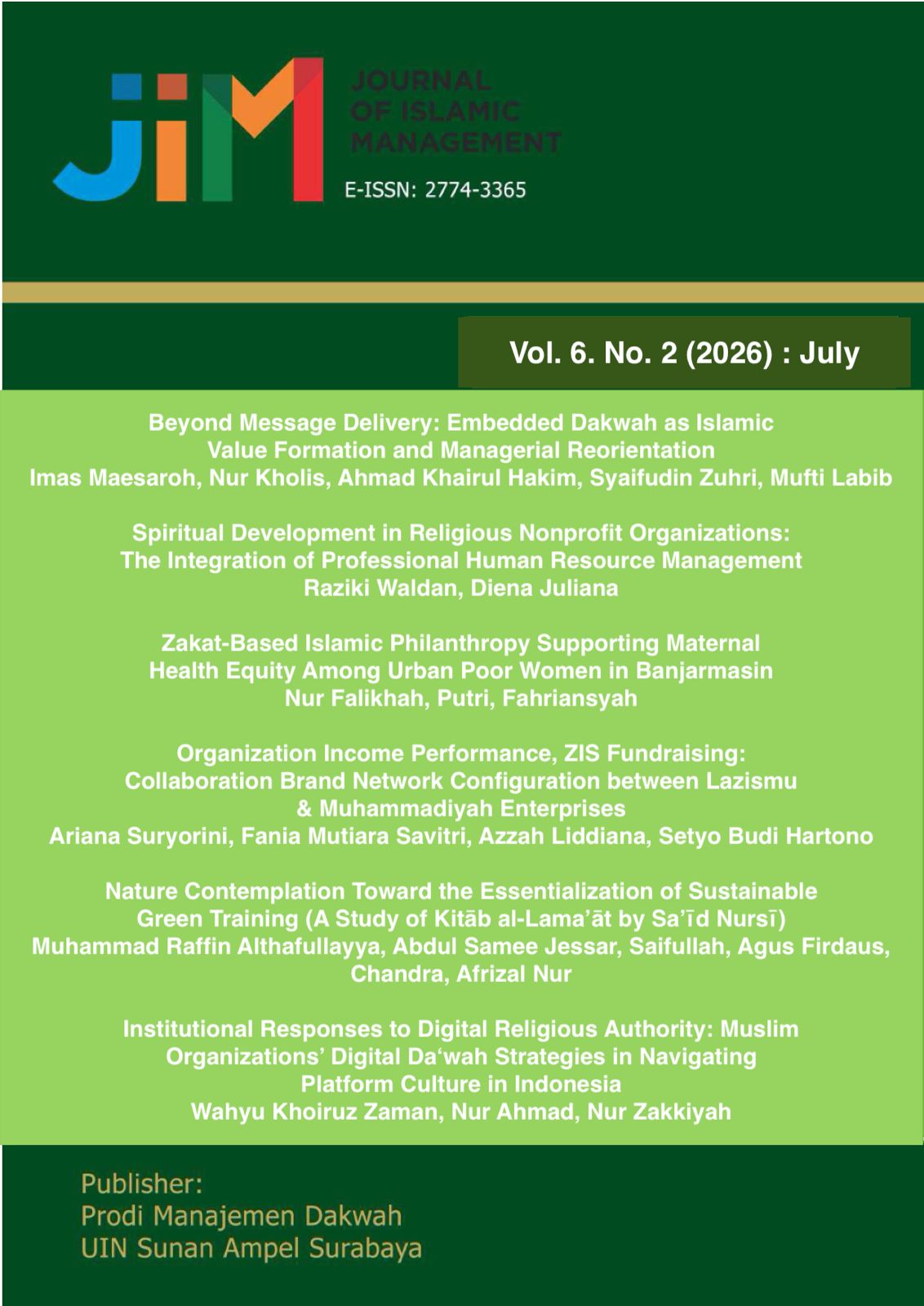
Organization Income Performance, ZIS Fundrising: Collaboration Brand Network Configuration between Lazismu & Muhammadiyah Enterprises
DOI:
https://doi.org/10.15642/jim.v6i2.2685Keywords:
Organization Income Performance, ZIS Fundraising, Collaboration Brand Network ConfigurationAbstract
Inter-organizational networks configured through the Collaboration Brand Network Configuration (Co-BNC) framework demonstrate significant potential in augmenting organizational income and expanding Zakat, Infaq, and Shodaqoh (ZIS) fund collection. This study investigates the Co-BNC model within Muhammadiyah and Lazismu Charity organizations, examining its role in optimizing organizational performance and ZIS fundraising outcomes. A quantitative approach employing Structural Equation Modeling and path analysis was adopted. Data were collected from AUM and Lazismu management personnel comprising 42 respondents, analyzed using WarpPLS 7. Findings demonstrate that Co-BNC significantly enhances ZIS collection through the mediating roles of brand awareness and organizational income performance. ZIS serves as the terminal proxy reflecting revenue generated from Co-BNC-based brand awareness formation between AUM and Lazismu. Optimally configured Co-BNC strengthens mutual brand reinforcement, elevates AUM profitability, expands zakat nisab thresholds, and enables cost-efficient network collaboration across Muhammadiyah institutions, collectively maximizing ZIS fundraising performance.
Downloads
References
Barney, J. (1991). Firm resources and sustained competitive advantage. Journal of Management,
(1), 99–120.
Black, I., & Veloutsou, C. (2017). Working consumers: Co-creation of brand identity,
consumer identity and brand community identity. Journal of Business Research, Vol. 70,
No. 1, pp. 416–429.
Bukhari, S. F. H., & Isa, S. M. (2020). Islamic branding: Insights from a conceptual analysis.
Journal of Islamic Marketing, 11(6), 1397–1413.
Cohen, J. (1988). Statistical power analysis for the behavioral sciences (2nd ed.). Lawrence
Erlbaum Associates.
Creswell, J. W., & Poth, C. N. (2016). Qualitative inquiry and research design. Sage Publications.
de Vries, L., & Leeflang, P. S. H. (2012). Popularity of brand posts on brand fan pages: An
investigation of the effects of social media marketing. Journal of Interactive Marketing,
(2), 83–91.
Djafri, F. and Noordin, K. (2017), “The impact of workplace spirituality on organizational
commitment: a case study of takaful agents in Malaysia”, Humanomics, Vol. 33 No.
, pp. 384-396, doi: 10.1108/H-02-2017-0018.
Fornell, C., & Larcker, D. F. (1981). Evaluating structural equation models with unobservable
variables and measurement error. Journal of Marketing Research, 18(1), 39–50.
Ghozali, I., & Latan, H. (2017). Partial least squares: Konsep, teknik, dan aplikasi
menggunakan program SmartPLS 3.0 (2nd ed.). Badan Penerbit Universitas Diponegoro.
Hair, J. F., Henseler, J., Dijkstra, T. K., Sarstedt, M., Ringle, C. M., Diamantopoulos, A., ... &
Calantone, R. J. (2014). Common beliefs and reality about PLS: Comments on
Rönkkö and Evermann (2013). Organizational Research Methods, 17(2), 182–209.
Hair, J. F., Risher, J. J., Sarstedt, M., & Ringle, C. M. (2019). When to use and how to report
the results of PLS-SEM. European Business Review, 31(1), 2–24.
Harrington, W.J., Preziosi, R.C. and Gooden, D.J. (2001), “Perceptions of workplace
spirituality among professionals and executives”, Employee Responsibilities and Rights
Journal, Vol. 13 No. 3, pp. 155-163, doi: 10.1023/A:1014966901725.
Hatch, M. J., & Schultz, M. (2010). Toward a theory of brand co-creation with implications
for brand governance. Journal of Brand Management, Vol, No. 8, pp. 590–604.
Iglesias, O., & Bonet, E. (2013). Persuasive brand management: How managers can influence
brand meaning when they are losing control over it. Journal of Organizational Change
Management, Vol. 25, No. 2, pp. 251–264.
Iglesias, O., Ind, N., & Alfaro, M. (2013). The organic view of the brand: A brand value co-
creation model. Journal of Brand Management, 20(8), 670–688.
Downloads
Published
Versions
- 2026-08-09 (2)
- 2026-07-31 (1)
How to Cite
Issue
Section
License
Copyright (c) 2026 Fania Savitri, Ariana Suryorini, Azzah Liddiana, Setyo Hartono

This work is licensed under a Creative Commons Attribution-ShareAlike 4.0 International License.