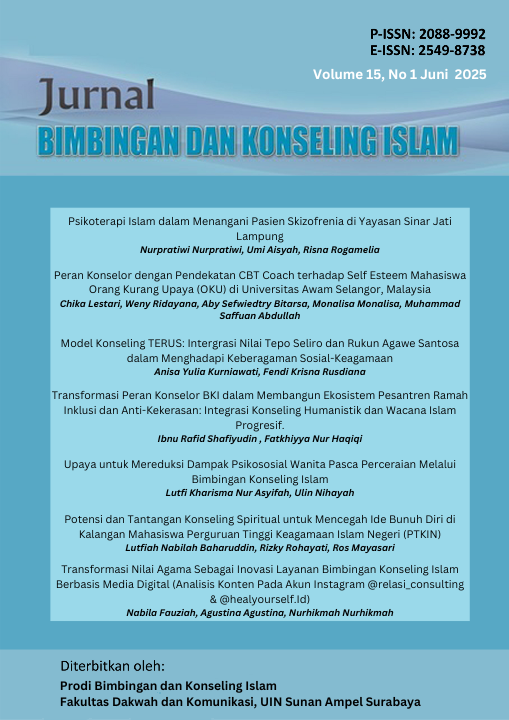
Psikoterapi Islam dalam Menangani Pasien Skizofrenia di Yayasan Sinar Jati Lampung
DOI:
https://doi.org/10.29080/jbki.2025.15.1.01-10Keywords:
Islamic Psychotherapy, Schizophrenia, Mental RehabilitationAbstract
Schizophrenia is a complex mental disorder that affects the cognitive, emotional, and behavioral aspects of sufferers. At the Sinar Jati Lampung Foundation, the majority of schizophrenia cases are caused by drug abuse. This study examines the effectiveness of Islamic psychotherapy as an alternative therapy modality in the rehabilitation of schizophrenia patients. Conventional approaches that rely on medical-pharmacological interventions often fail to adequately address the psychosocial aspects of patients. Islamic psychotherapy offers a holistic approach that integrates the spiritual dimension to achieve psychological balance and improve quality of life. The research method uses a descriptive qualitative approach with a field research design. The research subjects consisted of 7 informants: 1 counselor, 1 social worker, 1 spiritual guide, and 4 schizophrenia patients. The results of the study identified the application of Islamic psychotherapy through four stages: preparation and planning, orientation and socialization, implementation including ritual worship, dhikr, and religious studies, and evaluation of therapy progress. Islamic psychotherapy has a positive impact on the psychological and spiritual stability of patients, contributing significantly to the recovery of schizophrenia.
Downloads
References
Chong, Huey Yi, Siew Li Teoh, David Bin Chia Wu, Surachai Kotirum, Chiun Fang Chiou, and Nathorn Chaiyakunapruk. 2016. “Global Economic Burden of Schizophrenia: A Systematic Review.” Neuropsychiatric Disease and Treatment 12:357–73. https://doi.org/10.2147/NDT.S96649.
Creswell, John W. 2009. “Qualitative, Quantitative, and Mixed-Methods Research.” Microbe Magazine 4 (11): 485–485. https://doi.org/10.1128/microbe.4.485.1.
———. 2012. Educational Research: Planning, Conducting, and Evaluating Quantitative and Qualitative Research. Edited by Paula A. Smith. Sustainability (Switzerland). Fourth Edi. Vol. 11. University of Nebraska–Lincoln.
Ghazali, Bahri. 2016. “10. Kesehatan Mental 1 Ok.” Early Childhood Education Journal, no. November 2019, 1–102.
Hafil, Ach. Shodiqil, Tatik Imadatus Sa’adati, and Muhamad Bagus. 2023. “The Effectiveness of Islamic Psychotherapy with Zikr Asmaul Husna in Improving the Sleep Quality of Schizophrenic Clients in UPT Rehabilitasi Sosial Bina Laras Kediri.” Happiness: Journal of Psychology and Islamic Science 7 (2): 153–62. https://doi.org/10.30762/happiness.v7i2.1318.
Haque, A. 2004. “Psychology from Islamic Perspective: Contributions of Early Muslim Scholars and Challenges to Contemporary Muslim Psychologists.” Journal of Religion and Health 43, 357–377 (2004) 43:357–77.
Idaiani, Sri, Indri Yunita, Dwi Hapsari Tjandrarini, Lely Indrawati, Ika Darmayanti, Nunik Kusumawardani, and Rofingatul Mubasyiroh. 2019. “Prevalensi Psikosis Di Indonesia Berdasarkan Riset Kesehatan Dasar 2018.” Jurnal Penelitian Dan Pengembangan Pelayanan Kesehatan 3 (1): 9–16. https://doi.org/10.22435/jpppk.v3i1.1882.
Irawati, Kellyana, Ferika Indarwati, Fahni Haris, Jing-Yi Lu, and Yin-Hwa Shih. 2023. “Religious Practices and Spiritual Well-Being of Schizophrenia: Muslim Perspective.” Psychology Research and Behavior Management 16 (March):739–48. https://doi.org/10.2147/PRBM.S402582.
Juliarti Dewi. 2011. No Title.
Kevin, Volkan. 2020. “Schizophrenia: Epidemiology, Causes, Neurobiology, Pathophysiology, and Treatment” 3 (4).
Koenig, Harold G. 2012. “Religion, Spirituality, and Health: The Research and Clinical Implications.” ISRN Psychiatry 2012:1–33. https://doi.org/10.5402/2012/278730.
Mayang Ambari, Kartika Prinda. 2010. “Hubungan Antara Dukungan Keluarga Dengan Keberfungsian Sosial Pada Pasien Skizofrenia Pasca Perawatan Di Rumah Sakit.” Other, Universitas Diponegoro. https://eprints.undip.ac.id/10956/.
Nikfarjam, Masoud. 2011. “The Efficacy of Religious Training (Prayer) on the Improvement of the Schizophrenic Patients’ Quality of Life at Sina Psychiatric Hospital (Bakhtiari Province, 2011).” Journal of Arak University of Medical Sciences 13 (5): 133–38.
Rosidi, Rosidi, and Umi Aisyah. 2020. “Psikoterapi Islam Untuk Penyembuhan Penderita Gangguan Jiwa Di Pondok Pesantren Al-Hikmatul Qur’an Kecamatan Kedondong Kabupaten Pesawaran.” Jurnal Bimbingan Dan Konseling Islam 10 (2): 132–40. https://doi.org/10.29080/jbki.2020.10.2.132-140.
Sari, Puspita. 2019. “Dinamika Psikologi Penderita Skizofrenia Paranoid Yang Sering Mengalami Relapse.” Psikoislamedia Jurnal Psikologi 4 (2): 124–36.
Tiza Husna, Mai, and Meza Saputri. 2024. “Sufism as Psychotherapy to Overcoming Relapse in Schizophrenic Patients Tasawuf Sebagai Psikoterapi Mengatasi Relaps Pada Penderita Skizofrenia” 21 (1): 2655–5034.
Zuchri Abdussamad, Dr. H. 2019. Metode Penelitian Kualitatif. Sustainability (Switzerland). Vol. 11.
Downloads
Published
How to Cite
Issue
Section
License
Copyright (c) 2025 Nurpratiwi Nurpratiwi, Umi Aisyah, Risna Rogamelia

This work is licensed under a Creative Commons Attribution 4.0 International License.
Licensing
© The Author(s). Published by Jurusan Bimbingan dan Konseling Islam, Fakultas Dakwah, UIN Sunan Ampel Surabaya, Indonesia.
This is an Open Access article distributed under the terms of Attribution 4.0 International (CC BY 4.0).