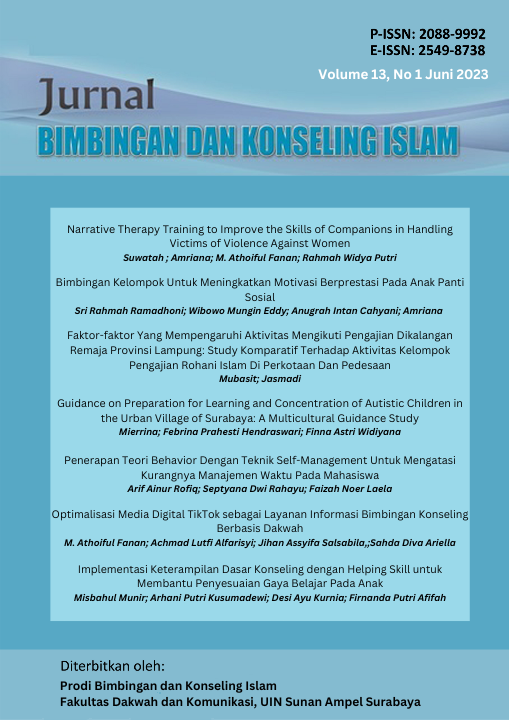
Penerapan Teori Behavior Dengan Teknik Self-Management Untuk Mengatasi Kurangnya Manajemen Waktu Pada Mahasiswa
DOI:
https://doi.org/10.29080/jbki.2023.13.1.52-69Keywords:
Behavior Therapy;, Self Management, MahasiswaAbstract
The focus of this research is: 1. What is the condition of the counselee before the Application of Behavior Theory by Using Self-Management Techniques to Overcome Lack of Time Management in College Student? 2. What is the process of applying Behavior Theory by Using Self-Management Techniques to Overcome Lack of Time Management in College Student? 3. What is the impact of the Application of Behavior Theory by Using Self-Management Techniques to Overcome the Lack of Time Management in College Student?. To be able to answer these problems, in the research above, this study used descriptive qualitative research methods. The data collection techniques are interviews, field observations which have been described in the data presentation chapter. The implementation process is based on the five-step counseling process, namely: problem identification, diagnosis, prognosis, treatment or therapy, evaluation and follow-up. The end result of this study is that after carrying out the counseling process and applying behavior therapy with self-management techniques, there is a change in the counselee's behavior. These changes can be seen from the counselee who is able to control himself and manage his time well. These changes are seen gradually after the treatment process is applied
Downloads
References
Annisa. 2018. “Efektivitas Konseling Behavioral Dengan Teknik Self-Management Untuk Meningkatkan Kecerdasan Emosional Peserta Didik Kelas VII Di SMP Negeri 19 Bandar Lampung Tahun Ajaran 2017/2018”, SKRIPSI.
Atosokhi, Gea Antonius. 2014. "Time management: Menggunakan waktu secara efektif dan efisien." Humaniora 5, no. 2.
Furlonger, Brett. 2017. “Using a Single-Case Experimental Design to Evaluate a CognitiveBehavioural Self-Management Counselling Intervention Intervention”, Asia Pacific Journal of Counselling and Psychotherapy.
Komalasari, Komalasari, Eka Wahyuni, Karsih. 2014. Teori Dan Teknik Konseling, Jakarta:PT Indeks.
Macan, Therese Hoff, Comila Shahani, Robert L. Dipboye, dan Amanda Peek Phillips. T.th. “College Students’ Time Management: Correlations With Academic Performance and Stress.” Journal of Educational Psychology 82 (4).
Mediana, E. 2008. Sesi VI: Manajemen Waktu, Jakarta: Universitas Mercu Buana.
Moleong, Lexy J. 2017. Metodologi Penelitian Kualitatif, Bandung: PT. Remaja Rosdakarya.
Monica, Mega Aria, and Ruslan Abdul Gani. 2016 "Efektivitas layanan konseling behavioral dengan teknik self-management untuk mengembangkan tanggung jawab belajar pada peserta didik Kelas XI SMA Al-Azhar 3 Bandar Lampung tahun ajaran 2015/2016." KONSELI: Jurnal Bimbingan dan Konseling (E-Journal) 3, no. 2.
Sanyata, Sigit. 2012. "Teori dan aplikasi pendekatan behavioristik dalam konseling." Jurnal Paradigma 14, no. 7.
Sugiyono. 2008. Metode Penelitian Kuantitatif Kualitatif dan R&D, Bandung: CV. Alfabeta.
Sule, Ernie Tisnawati dan Kurniawan Saefullah. 2013. Pengantar Manajemen, Jakarta: Kencana Prenadamedia Group.
Surur, Agus Miftakus and Ana Ulin Nadhirin. 2020. "Manajemen Waktu Pembelajaran Daring Di Masa Pandemi Covid-19 Pada TK Dharma Wanita 1 Baleturi”, As-Sibyan: Jurnal Pendidikan Anak Usia Dini 5, no. 2.
T, Tohirin. 2012. Metode Penelitian Kualitatif dalam Pendidikan dan Bimbingan Konseling, Jakarta: PT. Raja Grafindo.
Downloads
Published
How to Cite
Issue
Section
License
Copyright (c) 2023 Arif Ainur Rofiq, Septyana Dwi Rahayu, Faizah Noer Laela

This work is licensed under a Creative Commons Attribution 4.0 International License.
Licensing
© The Author(s). Published by Jurusan Bimbingan dan Konseling Islam, Fakultas Dakwah, UIN Sunan Ampel Surabaya, Indonesia.
This is an Open Access article distributed under the terms of Attribution 4.0 International (CC BY 4.0).