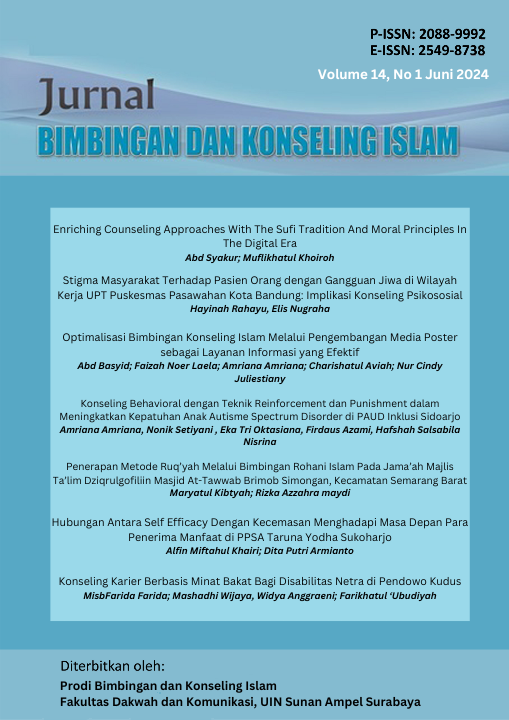
Enriching Counseling Approaches With The Sufi Tradition And Moral Principles In The Digital Era
DOI:
https://doi.org/10.29080/jbki.2024.14.1.01-18Keywords:
sufistic counseling,, negative impacts of the digital era;, social media addiction;, mental-spiritual illness.Abstract
This article examines sufistic moral teachings as a basis for building an Islamic counseling model to overcome the negative impacts of the digital era such as addiction to online gambling, pornography, etc. This study is using qualitative model. The main data is about the doctrine and practice of sufism and Islamic moral principles; about the negative impact of social media which damages personality. Data is taken from books, journal articles, and scientific works using documentation technique. The collected data was analyzed using analytical-synthetic thinking technique. The result is; first, the digital era which makes life easier, turns out to have negative psychological-spiritual impact. For example, being apathetic, anti-social etc. Second, sufis are credited with providing a path to purity of heart, thereby making the soul healthy and happy. Their spiritual practices are appropriate to be an alternative in bulding Islamic counseling stategies. Primarily, to deal with mental health problems as a negative impact of social media. Among others are; 1) fa’ali counseling in the form of practicing righteous deeds which is based on Wahb bin Munabbih's spiritual practices. The aim is to eliminate laziness; 2) counseling for ‘grave pilgrimage’ which was built from Abdullah al-Imari's spiritual experience. The practice is; someone intends to visit a cemetery to meditate; make oneself aware (contemplate/tafakkur-tadhakkur), take lessons from the grave phenomenon; dhikr and pray to get the strength to fill life in the world with good deeds; 3) khauf and raja’ energy-based ascetic counseling based on Hasan al-Basriy's spiritual experience.
Downloads
References
Abdullah, W. S. W. (1999). Konsep Maqamat dan Ahwal Sufi: Suatu Penilaian. Jurnal Usuluddin, 10, 51–62.
Al, K. A. B. M. S., Ma’arif, M. L., & Prasetiawati, E. (t.t.). Analisis Isra’iliyyat Dalam Tafsir Hasyiah Al-Sawi. Diambil 27 Mei 2024, dari https://www.academia.edu/download/101723016/pdf.pdf
Amida, I. A., & Nugraha, B. K. (2024). Analysis of the Concept of Self-Awareness in Sufism and its Implications in the Guidance Counseling Process. Formosa Journal of Sustainable Research, 3(1), 171–182.
Amri, M., & Santalia, I. (2023). Ajaran Tasawuf dan Tokoh-Tokohnya. Jurnal Ilmu Pendidikan dan Sosial, 1(4), 549–559.
Aziz, A., & Lestari, P. (2024). PERAN TASAWUF UNTUK KESEHATAN MENTAL MASYARAKAT MODERN. Jurnal Review Pendidikan dan Pengajaran (JRPP), 7(2), 5383–5388.
Badrudin, B., & Nur’aeni, E. (2024). Etika Sufisme: Karakteristik Dan Implementasinya. http://repository.uinbanten.ac.id/14510/2/Buku%20Etika%20sufisme-isbn-ok.pdf
Basuki, U. J. (2023). PSIKOTERAPI ISLAM MELALUI METODE SUFISTIK UNTUK MENGATASI GANGGUAN KEJIWAAN. SENRIABDI, 96–112.
Elfando, M. E., & Nurwahidin, N. (2023). The Relevance of Amali Sufism and Philosophical Sufism in Modern Times. Nizham: Jurnal Studi Keislaman, 11(02), 187–201.
Fuaody, C. N., Anggraeni, I., Maulidia, L., & Nugraha, R. G. (2024). Analisis Pengaruh Digital terhadap Komunisasi Sosial Anak dalam Kehidupan Sehari–Hari. Jurnal Basicedu, 8(1), 327–337.
Ginting, D. C. A., gusti Rezeki, S., Siregar, A. A., & Nurbaiti, N. (2024). Analisis Pengaruh Jejaring Sosial Terhadap Interaksi Sosial di Era Digital. PPIMAN: Pusat Publikasi Ilmu Manajemen, 2(1), 22–29.
Hisan, K., Hamidah, N., Rosspertiwi, A. A., & Murdiana, V. (2024). Peran Konsep Diri dalam Mengurangi Konsekuensi Psikologis dari Cyberbullying. Observasi: Jurnal Publikasi Ilmu Psikologi, 2(1), 107–113.
Hutabarat, R. K. (2024). Interaksi Sosial di Era Digital: Dampak Media Sosial Terhadap Perubahan Budaya. Pragmatik: Jurnal Rumpun Ilmu Bahasa dan Pendidikan, 2(1), 106–110.
Jariyah, F. A., Sudirman, N., Damayanti, N., & Marsuki, N. R. (2024). The Influence Of The Digital Revolution On Mental Health And Emotional Well-Being In Everyday Life. Jurnal Mahasiswa Kreatif, 2(1), 174–184.
Kahfi, R., Aisyah, S. N., Hijriyah, H., & Nasution, D. R. N. (2023). Klasifikasi Tasawuf: Amali, Falsafi, Akhlaki. Jurnal Pendidikan dan Konseling (JPDK), 5(1), 4073–4079.
Maryam, S. (2022). Pendidikan Agama Islam dalam Persepektif Psikologi dan Tasawuf. BAHTSUNA: Jurnal Penelitian Pendidikan Islam, 4(2), 170–187.
Nafisah, D., & Rusydi, M. (2024). Sufism Asmaran Think. Jurnal Scientia, 13(01), 201–209.
Nurhakim, M. (2024). Implementasi Tasawuf dalam Pendidikan Agama Islam di Sekolah. Al Iman: Jurnal Keislaman dan Kemasyarakatan, 8(1), 75–92.
Pangeran, M. P. A. T. I., Fanani, M. R., & Ud, M. (t.t.). PERAN TASAWUF DALAM KEHIDUPAN MODERN. Diambil 27 Mei 2024, dari https://www.ejurnal.iaipd-nganjuk.ac.id/index.php/spiritualis/article/view/893
Qudsiyyah, F., Hanipudin, S., & Sajidin, S. (2024). Pendidikan Tasawuf dalam Kitab Al-Hikam Karya Syekh Ibnu Atha’illah As-Sakandari. Tafhim Al-’Ilmi, 15(02), 204–217.
Sahibuddin, S. (2014). Dinamika Tasawwuf Dalam Dunia Modern. Jurnal Al-Ulum, Universitas Islam Madura, 2(1), 7–7.
Sakdiah, H., Ilham, I., Wildan, M., & Rif’at, M. (2023). Konseling Sufistik sebagai Upaya Pengembangan Fitrah Manusia. Al-Hiwar Jurnal Ilmu dan Teknik Dakwah, 11(1), 9–19.
Sembiring, Q. B. (2024). DAMPAK TEKNOLOGI DIGITAL TERHADAP KESEHATAN MENTAL GENERASI MUDA. Circle Archive, 1(4). http://circle-archive.com/index.php/carc/article/view/65
Shufi, L. (2023). Moral Education in the Concept of Mahabbah Rabi’ah Al-Adawiyah: Al-Hubb Al-Illahi. Proceeding International Seminar and Conference on Islamic Studies (ISCIS), 2(1). https://jurnal.uinsu.ac.id/index.php/ISCIS/article/view/17664
Sitompul, A. V. (2024). PENGARUH MEDIA SOSIAL TERHADAP PERSEPSI DIRI DAN KESEHATAN MENTAL REMAJA. Circle Archive, 1(4). http://www.circle-archive.com/index.php/carc/article/view/101
Turnip, E. Y., & Siahaan, C. (2021). Etika berkomunikasi dalam era media digital. Jurnal Ekonomi, Sosial & Humaniora, 3(04), 38–45.
Yahya, M. A., Mahaiyadin, M. H., & Osman, A. S. (2024). The Role Of Sufism And Tarekat In The Spiritual Construction Of Quality Humans: Peranan Tasawuf Dan Tarekat Dalam Pembinaan Spiritual Insan Yang Berkualiti. al-Qanatir: International Journal of Islamic Studies, 33(2), 51–61.
Yanti, M., & Bahagia, M. (2023). CINTA ILAHI (MAHABBAH) SUFI WANITA: RABI’AH AL-ADAWIYAH. Jurnal Ekshis, 1(2), 47–60.
Downloads
Published
How to Cite
Issue
Section
License
Copyright (c) 2024 Abd Syakur, Muflikhatul Khoiroh

This work is licensed under a Creative Commons Attribution 4.0 International License.
Licensing
© The Author(s). Published by Jurusan Bimbingan dan Konseling Islam, Fakultas Dakwah, UIN Sunan Ampel Surabaya, Indonesia.
This is an Open Access article distributed under the terms of Attribution 4.0 International (CC BY 4.0).