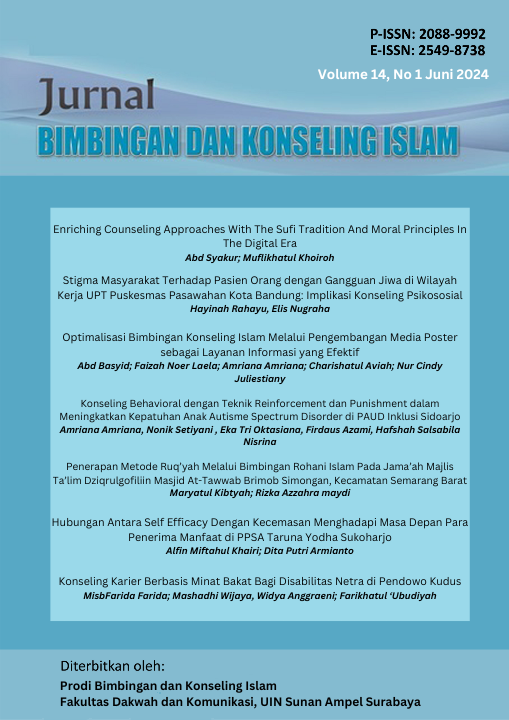
Konseling Behavioral dengan Teknik Reinforcement dan Punishment dalam Meningkatkan Kepatuhan Anak Autisme Spectrum Disorder di PAUD Inklusi Sidoarjo
DOI:
https://doi.org/10.29080/jbki.2024.14.1.45-56Keywords:
Konseling behavior;, Reinforcement;, Punishment;, Autism Spectrum Disorder;, InklusiAbstract
This study aims to describe the implementation of behavioral counseling with reinforcement and punishment techniques to improve compliance among children with Autism Spectrum Disorder (ASD) at an inclusive preschool in Sidoarjo. The research employed a descriptive qualitative approach with data collected through observation, interviews, and documentation. Data were analyzed using thematic analysis techniques, involving data reduction, categorization, and interpretation to identify behavior patterns and intervention effectiveness. The study was conducted over five weeks on two twin children with ASD who exhibited different behavioral characteristics. Positive reinforcement was applied to increase adaptive behaviors such as task focus and compliance with instructions, using praise, thumbs-up gestures, and rewards. Results showed that this technique effectively enhanced the motivation and positive responses of both subjects. Punishment was used to reduce maladaptive behaviors, such as tantrums and hitting, by implementing consequences such as placing the child in a designated tantrum room. This technique was found effective in reducing the frequency of negative behaviors, especially when consistently implemented by teachers at school and supported by parents at home. This study provides practical contributions for teachers, counselors, and parents in creating a supportive learning environment through structured behavioral counseling applications. Collaboration between schools and families is crucial for the success of interventions, helping children with ASD develop their full potential.
Downloads
References
Al-Qur'an.
American Psychiatric Association. (2013). Diagnostic and statistical manual of mental disorders (5th ed.). Washington, DC: Author.
Arini, Septiana dan Kurniawati, Farida, Sikap Guru terhadap Anak Usia Dini dengan Autism Spectrum Disorder, Jurnal Obsesi : Jurnal Pendidikan Anak Usia Dini, Vol. 4 No. 2, 2020.
Bogdan, R. C., & Biklen, S. K. (1992). Qualitative research for education: An introduction to theory and methods. Boston: Allyn & Bacon.
Braun, V., & Clarke, V. (2006). Using thematic analysis in psychology. Qualitative Research in Psychology, 3(2), 77–101. https://doi.org/10.1191/1478088706qp063oa
Breadley T. Erford, 40 Teknik yang Harus Di ketahui Setiap Konselor,( Yogyakarta:Pustaka Pelajar, 2015)
Carolina Hendarko, Anita dan Anggraika, Ike, Efektivitas Teknik Prompting dan Positive Reinforcement untuk Meningkatkan Frekuensi Kontak Mata pada Anak Prasekolah dengan Autisme, Jurnal Psikogenesis, Vol. 6, No.2, 2018
Creswell, J. W. (2014). Research design: Qualitative, quantitative, and mixed methods approaches (4th ed.). Thousand Oaks, CA: Sage.
Diane E. Berkell, Identification, Education, and Treatment, (New Jersey : Lawrence Erlbaum Associates, Inc, 1992).
Gelgel, N. (2002). Penguatan positif dan pengelolaan perilaku. Jurnal Pendidikan Anak Usia Dini, 4(2), 45–56.
Haryu Islamuddin, Psikologi Pendidikan (Yogyakarta: Pustaka Belajar, 2012)
Hendarko, A. C., & Anggraika, I. (2018). Efektivitas teknik prompting dan positive reinforcement untuk meningkatkan frekuensi kontak mata pada anak prasekolah dengan autisme. Jurnal Psikogenesis, 6(2), 177–183.
Mirnawati. (2020). Modifikasi perilaku anak berkebutuhan khusus. Sukoharjo: CV Oase Pustaka.
Moleong, L. J. (2019). Metodologi penelitian kualitatif (Edisi revisi). Bandung: PT Remaja Rosdakarya.
Novarianing Asri, Dahlia dan Suharni, 2021, Modifikasi Perilaku, Madiun : UNIPMA Press.
Petra Fridolina, Elizabet, Maryati Deliana, Sri dan Sugiyo Pranoto, Yuli Kurniawati, The Training of Self-Help Eating Ability of the Autism Spectrum Disorder Student using Social Reinforcement Intervention in Early Childhood, Vol. 9 No. 1, 2020.
Purwoko, Kristianto, Dkk, Faktor-faktor yang Mempengaruhi Kepatuhan Terhadap Pengendalian Intern Factors Affecting Compliance with Internal Control. Jurnal Riset Akuntansi dan Auditing, VoL. 9, No. 3, 2022.
S, Milgram, “Behavioral Study of Obedience,” Journal of Abnormal and Social Psychology, 67, 1963.
S.E., Taylor Dkk, 2019, Psikologi Social Edisi Kedua Belas, Jakarta : Kencana.
Skinner, B. F. (1953). Science and human behavior. New York: Macmillan.
Supari, S. F. (2006). Peningkatan prevalensi autisme di Indonesia: Implikasi bagi kebijakan kesehatan masyarakat. Jurnal Kesehatan Masyarakat, 12(3), 213–218.
Zeidan, J., et al. (2022). Global prevalence of autism spectrum disorder: A systematic review. Autism Research, 15(1), 33–45.
Downloads
Published
How to Cite
Issue
Section
License
Copyright (c) 2024 Amri Ana, Nonik Setiyani , Eka Tri Oktasiana, Firdaus Azami, Hafshah Salsabila Nisrina

This work is licensed under a Creative Commons Attribution 4.0 International License.
Licensing
© The Author(s). Published by Jurusan Bimbingan dan Konseling Islam, Fakultas Dakwah, UIN Sunan Ampel Surabaya, Indonesia.
This is an Open Access article distributed under the terms of Attribution 4.0 International (CC BY 4.0).