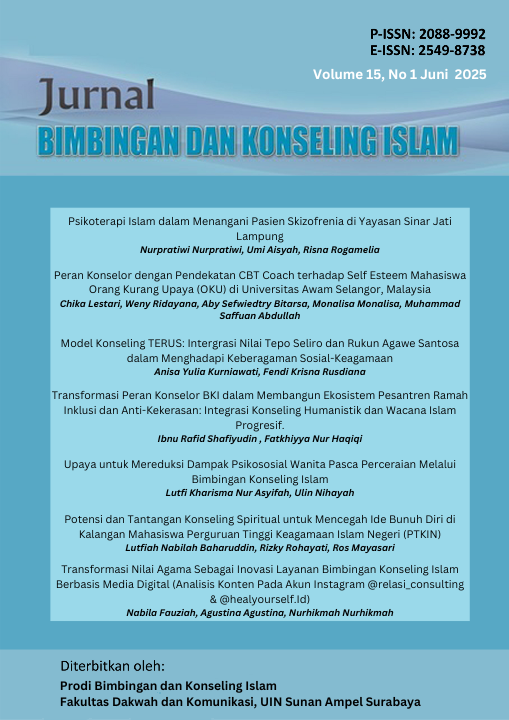
Upaya untuk Mereduksi Dampak Psikososial Wanita Pasca Perceraian Melalui Bimbingan Konseling Islam
DOI:
https://doi.org/10.29080/jbki.2025.15.1.45-60Keywords:
BKI, Psychosocial Impact, Post-Divorce WomenAbstract
This research aims to determine efforts to reduce the psychosocial impact of women after divorce through Islamic counseling. The subjects in this research were post-divorce women, the families of post-divorce women, and the community. The type of research used is qualitative research. The research results show that efforts that can be made to prevent and deal with psychosocial impacts on post-divorce women in order to achieve self-adjustment can be done through Islamic counseling guidance, including: (1) mental guidance in the form of increasing self-efficacy, obtaining social support from the surrounding environment, and increasing the number of positive activities, as well as (2) spiritual guidance to increase religiosity which is done by getting closer to Allah SWT, namely by understanding religious teachings correctly and practicing faith, Islam and sincerity in daily life such as praying, fasting, read the Koran, make dhikr, pray, perform sunnah worship, and establish friendship and good relations with other Muslims. The function of Islamic counseling guidance in an effort to reduce the psychosocial impact of post-divorce women focuses on preventive measures (preventive), problem handling (curative), improvement, adjustment and development in order to help post-divorce women develop their potential and have the ability to overcome every problem in his life.
Downloads
References
Abdullah, S. M. (2019). Social cognitive theory: Albert Bandura thought review published in 1982–2012. Psikodimensia, 18(1). https://doi.org/10.24167
Aini, N. (2015). Bimbingan dan konseling Islam dalam menangani dampak psikologis remaja akibat perceraian orang tua. Undergraduate thesis.
Alimuddin, N., & Rahmi, S. (2021). Peran bimbingan konseling Islam dalam menangani dampak psikologis remaja akibat perceraian. Jurnal Mahasiswa BK An-Nur, 7(3).
Anwar, M. F. (2019). Landasan bimbingan dan konseling Islam. Deepublish.
Bellot-Arcis, C., et al. (2013). Psychosocial impact of malocclusion in Spanish adolescents. Korean Journal of Orthodontics, 43(4). https://doi.org/10.4041/kjod.2013.43.4.193
Brown, C. (2006). Social psychology. Sage Publications.
Dariyo, A. (2004). Memahami psikologi perceraian dalam kehidupan keluarga. Jurnal Psikologi, 2(2).
Hafni, M. (2020). Effectiveness of social support with adolescent self-acceptance in post-divorce parents. Jurnal Inspira, 1(2), 38–42.
Herlany, S. (2022). Psikologi perempuan dewasa awal pasca perceraian. Sakina: Journal of Family Studies, 6(2).
Humairah, R. (2016). Dampak perceraian terhadap kondisi psikologis keluarga. Undergraduate thesis, UIN Ar-Raniry.
Hurlock, E. B. (2002). Psikologi perkembangan: Suatu pendekatan sepanjang rentang kehidupan. Erlangga.
Imron, A. A. (2012). Pencitraan perempuan pasca perceraian dalam perspektif gender. Egalita, 1. https://doi.org/10.18860/egalita.v0i0.1983
Karvistina, L. (2011). Persepsi masyarakat terhadap status janda. Undergraduate thesis, Universitas Negeri Yogyakarta.
Lestari, S. (2012). Psikologi keluarga: Penanaman nilai dan penanganan konflik dalam keluarga. Kencana.
Mahmudah. (2015). Bimbingan dan konseling keluarga perspektif Islam. CV Karya Abadi Jaya.
Moleong, L. J. (2006). Metodologi penelitian kualitatif. PT Remaja Rosdakarya.
Muardini, S., et al. (2019). Dampak perceraian pada perempuan usia muda di Kecamatan Pondok Tinggi Kota Sungai Penuh. Journal of Civic Education, 2(1). https://doi.org/10.24036/jce.v2i1.98
Muhammad, L. Y. B., et al. (2019). Religiusitas, dukungan sosial, stres, dan penyesuaian wanita bercerai. Jurnal Ilmu Keluarga dan Konsumen, 12(3). https://doi.org/10.24156/jikk.2019.12.3.194
Pragholapati, A. (2020). Dampak perceraian di Indonesia: A systematic literature review. Jurnal Keperawatan, 15(2).
Prasetya, M. A. (2014). Korelasi antara bimbingan konseling Islam dan dakwah. Addin, 8(2), 409–424.
Prihatiningtyas, S. (2019). Dakwah Islam dengan pendekatan bimbingan dan konseling. Jurnal Ilmu Dakwah, 38(2), 230. https://doi.org/10.21580/jid.v38.2.3885
Rasmun. (2004). Stres, koping, dan adaptasi. Sagung Seto.
Riyadi, A., & Adinugraha, H. H. (2021). The Islamic counseling construction in da’wah science structure. Journal of Advanced Guidance and Counseling, 2(1), 11–38. https://doi.org/10.21580/jagc.2021.2.1.6543
Rosya, E. (2019). Modul psikososial dan budaya dalam keperawatan. Universitas Esa Unggul.
Sari, D. S. (2021). Hubungan dukungan sosial dengan penerimaan diri pada remaja dengan orang tua bercerai. Literature review, STIKES Widyagama Husada Malang.
Surya, M. (2003). Bina keluarga. Aneka Ilmu.
Sutoyo, A. (2014). Bimbingan dan konseling Islami: Teori dan praktik. Pustaka Pelajar.
Thoits, P. A. (1995). Stress, coping, and social processes: Where are we? What next? Journal of Health and Social Behavior.
Zuhrotunisa. (2019). Dampak psikologis perceraian bagi anak dan istri serta solusinya dalam perspektif bimbingan konseling keluarga Islam. Thesis, UIN Walisongo Semarang.
Downloads
Published
How to Cite
Issue
Section
License
Copyright (c) 2025 Lutfi Kharisma Nur Asyifah, Ulin Nihayah

This work is licensed under a Creative Commons Attribution 4.0 International License.
Licensing
© The Author(s). Published by Jurusan Bimbingan dan Konseling Islam, Fakultas Dakwah, UIN Sunan Ampel Surabaya, Indonesia.
This is an Open Access article distributed under the terms of Attribution 4.0 International (CC BY 4.0).