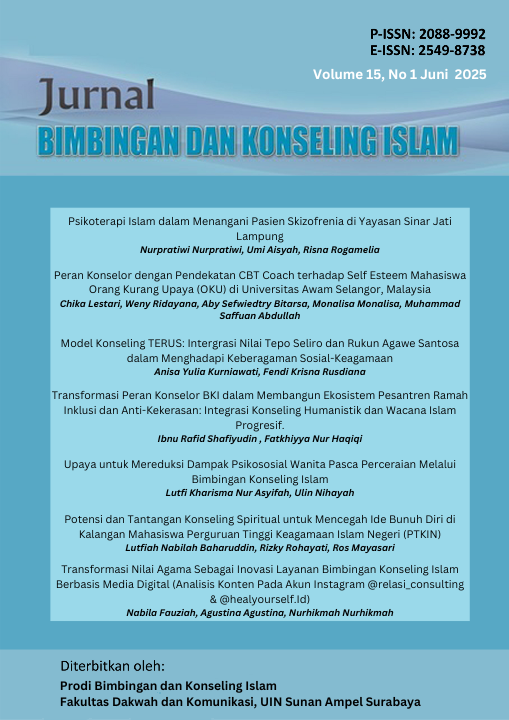
Potensi dan Tantangan Konseling Spiritual untuk Mencegah Ide Bunuh Diri di Kalangan Mahasiswa Perguruan Tinggi Keagamaan Islam Negeri (PTKIN)
DOI:
https://doi.org/10.29080/jbki.2025.15.1.61-84Keywords:
Suicide, Mental Health, Spiritual Counseling, University StudentsAbstract
The increasing rate of suicide among Indonesian university students reflects a serious mental health vulnerability caused by academic pressure, loneliness, loss of life meaning, and weak social support. This study explores the effectiveness of spiritual counseling in preventing student suicide and revitalizing its application in State Islamic Higher Education Institutions (PTKIN). Using a literature review of studies published between 2015 and 2025 from Google Scholar and Garuda Dikti, the analysis applies a narrative synthesis to identify core themes of concepts, strategies, and implementation models. Results indicate that spiritual counseling reduces suicidal ideation by strengthening life purpose, promoting positive religious coping, easing psychological distress, and stabilizing emotional well-being. Prior studies highlight the efficacy of dzikir therapy, religious reflection, and worship integration in enhancing students’ resilience. The study recommends improving counselor competence, engaging academic advisors, and ensuring institutional support so spiritual counseling becomes an effective preventive and curative mental health strategy.
Downloads
References
Aini, N. (2015). Bimbingan dan konseling Islam dalam menangani dampak psikologis remaja akibat perceraian orang tua. Al-Tazkiah, 7(1).
Alimuddin, N., & Rahmi, S. (2021). Peran bimbingan konseling Islam (BKI) dalam menangani dampak psikologis remaja akibat perceraian. Jurnal Mahasiswa BK An-Nur: Berbeda, Bermakna, Mulia, 7(3).
Anwar, M. F. (2019). Landasan bimbingan dan konseling Islam. Deepublish.
Brown, C. (2006). Social psychology. Sage Publications.
Dariyo, A. (2004). Memahami psikologi perceraian dalam kehidupan keluarga. Jurnal Psikologi, 2(2).
Hafni, M. (2020). Effectiveness of social support with adolescent self-acceptance in post-divorce parents. Jurnal Inspira, 1(2), 38–42.
Herlany, S. (2022). Psikologi perempuan dewasa awal pasca perceraian. Sakina: Journal of Family Studies, 6(2).
Hurlock, E. B. (2002). Psikologi perkembangan: Suatu pendekatan sepanjang rentang kehidupan. Erlangga.
Imron, A. A. (2012). Pencitraan perempuan pasca perceraian dalam perspektif gender. Egalita, 1. https://doi.org/10.18860/egalita.v0i0.1983
Lestari, S. (2012). Psikologi keluarga: Penanaman nilai dan penanganan konflik dalam keluarga. Kencana.
Mahmudah. (2015). Bimbingan dan konseling keluarga perspektif Islam. CV Karya Abadi Jaya.
Moleong, L. J. (2006). Metodologi penelitian kualitatif. PT Remaja Rosdakarya.
Prasetya, M. A. (2014). Korelasi antara bimbingan konseling Islam dan dakwah. Addin, 8(2), 409–424.
Prihatiningtyas, S. (2019). Dakwah Islam dengan pendekatan bimbingan dan konseling. Jurnal Ilmu Dakwah, 38(2), 230. https://doi.org/10.21580/jid.v38.2.3885
Rasmun. (2004). Stres, koping, dan adaptasi. Sagung Seto.
Riyadi, A., & Adinugraha, H. H. (2021). The Islamic counseling construction in da’wah science structure. Journal of Advanced Guidance and Counseling, 2(1), 11–38. https://doi.org/10.21580/jagc.2021.2.1.6543
Rosya, E. (2019). Modul psikososial dan budaya dalam keperawatan. Universitas Esa Unggul.
Surya, M. (2003). Bina keluarga. Aneka Ilmu.
Sutoyo, A. (2014). Bimbingan dan konseling Islami: Teori dan praktik. Pustaka Pelajar.
Downloads
Published
How to Cite
Issue
Section
License
Copyright (c) 2025 Lutfiah Nabilah Baharuddin, Rizky Rohayati, Ros Mayasari

This work is licensed under a Creative Commons Attribution 4.0 International License.
Licensing
© The Author(s). Published by Jurusan Bimbingan dan Konseling Islam, Fakultas Dakwah, UIN Sunan Ampel Surabaya, Indonesia.
This is an Open Access article distributed under the terms of Attribution 4.0 International (CC BY 4.0).