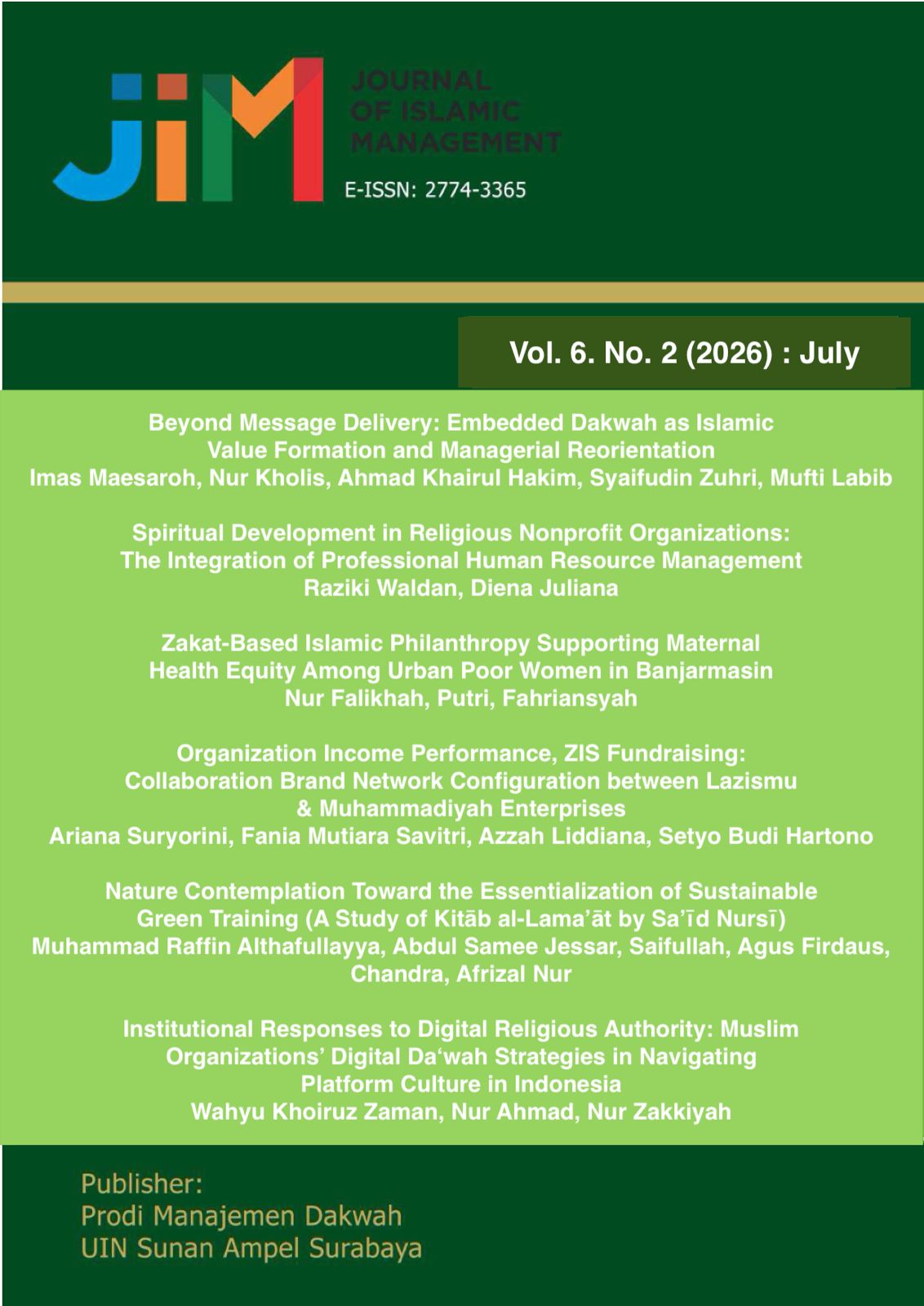
Spiritual Development in Religious Nonprofit Organizations: The Integration of Professional Human Resource Management
DOI:
https://doi.org/10.15642/jim.v6i2.2606Keywords:
Embedded Dakwah, Islamic Value Formation, Lived Religion , Collective Religious Practice, Local Culture , Dakwah ManagementAbstract
This study examines the integration of professional human resource management (HRM) and spiritual development within a religious nonprofit organization. Using a qualitative case study approach, the research was conducted at Masjid Ismuhu Yahya, Pontianak, Indonesia. Data were collected through in-depth interviews, direct observation, and document analysis involving mosque leaders, human resource managers, entrusted students, and staff members. The findings reveal that Masjid Ismuhu Yahya has implemented competency-based recruitment, structured training, and clear human resource classification aligned with professional HRM principles, while simultaneously embedding systematic spiritual development through religious routines and residential spiritual programs. This integration fosters human resources who are not only professionally competent but also possess strong spiritual values, integrity, and commitment. The study concludes that harmonizing professional HRM with spiritual development enhances organizational effectiveness, sustainability, and value-based identity. These findings contribute to the literature on human resource management in religious nonprofit organizations and offer practical insights for faith-based institutions seeking to balance professionalism and spirituality.
Downloads
References
Akinlade, D., Shalack, R., & Xavier, S. (2017). Strategic Human Resource Management In
Nonprofit Organizations: A Case For Mission-Driven Human Resource Practices.
Global Journal of Management and Marketing.
https://doi.org/10.47177/gjmm.01.01.2017.121
Ansari, N., , I., & Nurjaman, U. (2025). Relevansi Pengembangan Nilai-nilai Islami dalam
Bidang Manajemen Pendidikan. Al-Marsus : Jurnal Manajemen Pendidikan Islam.
https://doi.org/10.30983/al-marsus.v3i1.9656
Anwar, C., Sobandi, O., Ihsan, M., & Maliki, S. (2024). Implementation of National Morals
in Islamic Boarding Schools to Strengthen Religious Identity and Superior Character.
Atthulab: Islamic Religion Teaching and Learning Journal.
https://doi.org/10.15575/ath.v9i1.27149
Ardiansyah, A., Ms, E., & Musnaini, M. (2022). Pengaruh Dukungan Organisasi, Spritualitas
di Tempat Kerja Terhadap Kinerja Pegawai Melalui Komitmen Organisasi Sebagai
Variabel Intervening (Studi Kasus Badan Kesatuan Bangsa dan Politik Provinsi
Jambi). Ekonomis: Journal of Economics and Business.
https://doi.org/10.33087/ekonomis.v6i2.581
Aurannisa, N., & Azhari, W. (2025). Integrasi Kepemimpinan Spiritual dalam Fungsi
Perencanaan dan Actuating Manajemen Pendidikan Islam. An-Nahdloh: Journal of
Education and Islamic Studies. https://doi.org/10.58788/jeis.v1i1.2
Azizah, L., Hikmawati, H., & Muttaqin, M. (2025). Human Resource Management Through
Religious Programs for Student Character Development. Scaffolding: Jurnal Pendidikan
Islam dan Multikulturalisme. https://doi.org/10.37680/scaffolding.v7i1.7011
Baluch, A., & Ridder, H. (2020). Mapping the Research Landscape of Strategic Human
Resource Management in Nonprofit Organizations: A Systematic Review and
Avenues for Future Research. Nonprofit and Voluntary Sector Quarterly, 50, 598 - 625.
https://doi.org/10.1177/0899764020939653
Bastida, R., Marimon, F., & Carreras, L. (2018). Human Resource Management Practices and
Employee Job Satisfaction in Nonprofit Organizations. Public Economics: Fiscal Policies
& Behavior of Economic Agents eJournal. https://doi.org/10.1111/apce.12181
Downloads
Published
How to Cite
Issue
Section
License
Copyright (c) 2026 Raziki Waldan, Diena Juliana

This work is licensed under a Creative Commons Attribution-ShareAlike 4.0 International License.