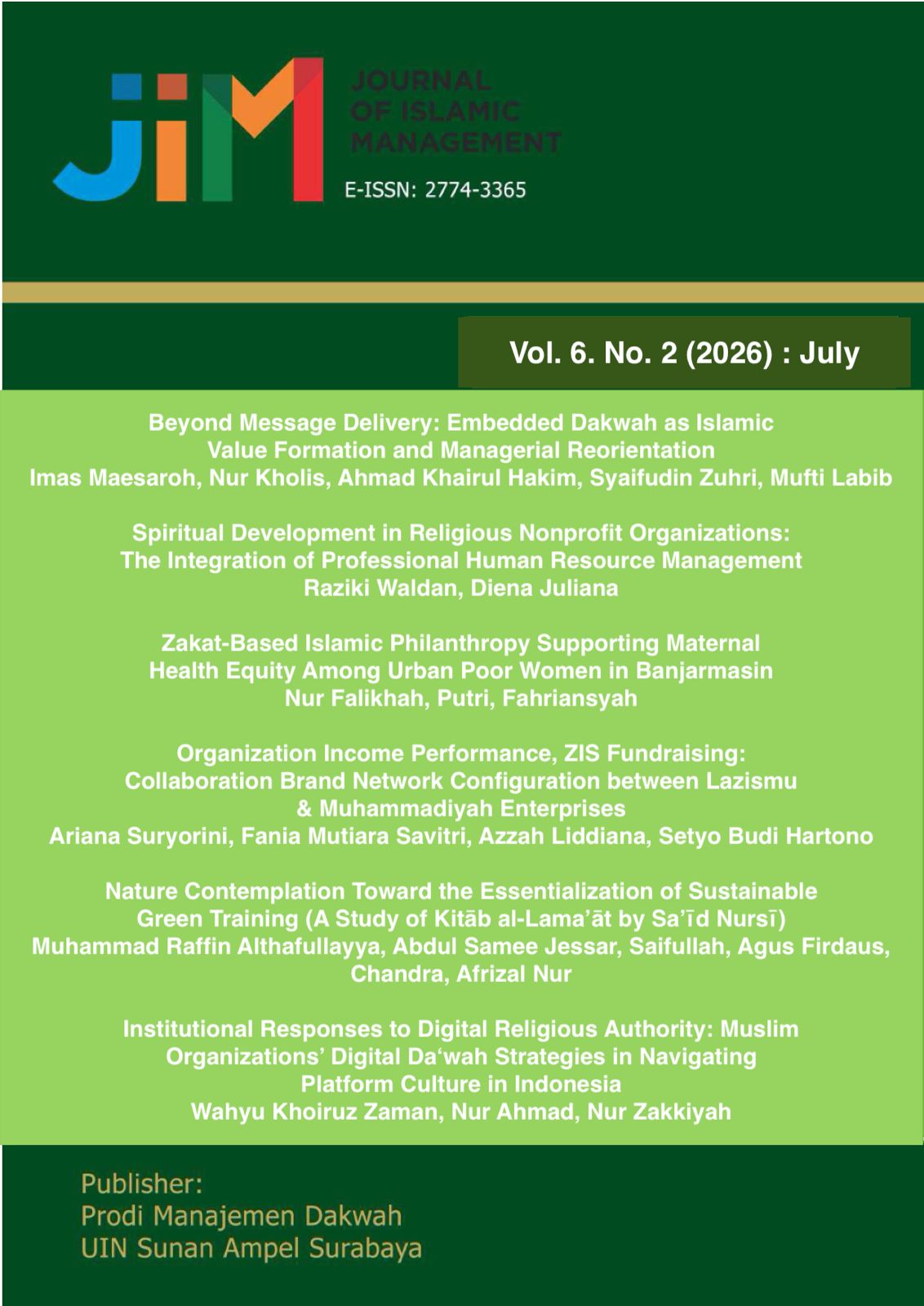
Beyond Message Delivery: Embedded Dakwah as Islamic Value Formation and Managerial Reorientation
DOI:
https://doi.org/10.15642/jim.v6i2.2762Keywords:
Embedded Dakwah, Islamic Value Formation, Lived Religion, Collective Religious Practice, Local Culture, Dakwah ManagementAbstract
This article develops the concept of embedded dakwah to explain how Islamic values are formed through everyday community life rather than only through verbal message delivery. Drawing on a narrative integrative review of dakwah studies, lived religion, social learning theory, ritual studies, community leadership, and religion–culture scholarship, the article identifies four domains of embedded dakwah: community leadership, everyday social interaction, collective religious practice, and local culture. It argues that Islamic value formation operates through four interrelated mechanisms: exemplary conduct, habituation, collective participation, and social norm reinforcement. The proposed framework is relational, contextual, and non-deterministic. Its formative effects depend on actor legitimacy, relational quality, power distribution, and community inclusivity. The article contributes to dakwah studies by shifting analytical attention from communication strategy and message transmission toward moral-social formation. It further develops an ecology-based organizational framework for dakwah institutions, covering leadership and governance, program design, the cultural and relational environment, and monitoring, as a practical guide for mosques, pesantren, and Islamic organizations seeking to cultivate Islamic values beyond event-based program delivery.
Downloads
References
Alatas, I. F. (2021). What is religious authority? Cultivating Islamic communities in Indonesia. Princeton
University Press.
Ammerman, N. T. (2021). Studying lived religion: Contexts and practices. New York University
Press.
Aziz, M. A. (2004). Ilmu dakwah. Kencana.
Azra, A. (2020). Pesantren and the Future of Islamic Education in Indonesia. Studia Islamika,
(2), 397–415. https://doi.org/10.15408/sdi.v27i2.15855
Bandura, A. (1977). Social learning theory. Prentice Hall.
Bandura, A. (1986). Social foundations of thought and action: A social cognitive theory. Prentice Hall.
Bandura, A. (2018). Toward a Psychology of Human Agency: Pathways and Reflections.
Perspectives on Psychological Science, 13(2), 130–136. https://doi.org/10.1177/1745691617699280
Berger, P. L., & Luckmann, T. (1966). The social construction of reality: A treatise in the sociology of
knowledge. Anchor Books.
Collins, R. (2004). Interaction ritual chains. Princeton University Press.
Durkheim, É. (1995). The elementary forms of religious life (K (E. Fields, Trans.). Free Press.
Fealy, G., & White, S. (Eds.). (2008). Expressing Islam: Religious life and politics in Indonesia. ISEAS
Publishing. https://doi.org/10.1355/9789812308528
Grusec, J. E., & Davidov, M. (2010). Integrating Different Perspectives on Socialization
Theory and Research: A Domain-Specific Approach. Child Development, 81(3), 687–
https://doi.org/10.1111/j.1467-8624.2010.01426.x
Hefner, R. W. (2000). Civil Islam. Princeton University.
Howell, J. D. (2008). Modulations of active piety: Professors and televangelists as promoters
of Indonesian “Sufisme. In G. Fealy & S. White (Eds.), Expressing Islam: Religious life
and politics in Indonesia (pp. 40–62). ISEAS Publishing.
Jaakkola, E. (2020). Designing conceptual articles: Four approaches. AMS Review, 10(1–2),
–26. https://doi.org/10.1007/s13162-020-00161-0
Khoirin, N., & Junaedi, M. (2022). Religious inconsistency on corruption behaviour among
Muslim politicians in Indonesia. HTS Teologiese Studies / Theological Studies, 78(4).
https://doi.org/10.4102/hts.v78i1.7361
Ma’arif, B. S. (2010). Komunikasi dakwah: Paradigma untuk aksi. Simbiosa Rekatama Media.
Madani, M. (2017). Fikih dakwah. Pustaka Baru Press.
Madjid, N. (2000). Islam doktrin dan peradaban: Sebuah telaah kritis tentang masalah keimanan,
kemanusiaan, dan kemodernan.
McGuire, M. B. (2008). Lived religion: Faith and practice in everyday life. Oxford University Press.
Mubarok, A. (2018). Psikologi dakwah. Kencana.
Muhyiddin, A. S. (2019). Dakwah Transformatif Kiai (studi terhadap gerakan transformasi
sosial KH. Abdurrahman Wahid). Jurnal Ilmu Dakwah, 39(1), 1.
https://doi.org/10.21580/jid.v39.1.3934
Narvaez, D. (2010). Moral Complexity. Perspectives on Psychological Science, 5(2), 163–181.
Downloads
Published
How to Cite
Issue
Section
License
Copyright (c) 2026 Imas Maesaroh, Nur Kholis, Ahmad Khairul Hakim, Airlangga Bramayudha, Syaifuddin Zuhri, Mufti Labib

This work is licensed under a Creative Commons Attribution-ShareAlike 4.0 International License.